
|
You entered: loops
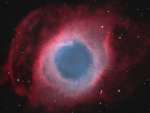 Spokes in the Helix Nebula
4.09.2008
At first glance, the Helix Nebula (aka NGC 7293), looks simple and round. But this well-studied example of a planetary nebula, produced near the end of the life of a sun-like star, is now understood to have a surprisingly complex geometry. Its extended loops and comet-shaped features have been explored in Hubble Space Telescope images.
 APOD: 2024 March 26 Б Comet Pons Brooks Ion Tail
26.03.2024
Comet Pons-Brooks has quite a tail to tell. First discovered in 1385, this erupting dirty snowball loops back into our inner Solar System every 71 years and, this time, is starting to put on a show for deep camera exposures.
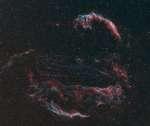 The Veil Nebula
16.09.2010
Delicate in appearance, these filaments of shocked, glowing gas, draped in planet Earth's sky toward the constellation of Cygnus, make up the Veil Nebula. The nebula is a large supernova remnant, an expanding cloud born of the death explosion of a massive star.
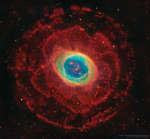 Rings Around the Ring Nebula
15.07.2018
There is much more to the familiar Ring Nebula (M57), however, than can be seen through a small telescope. The easily visible central ring is about one light-year across, but this remarkably deep exposure...
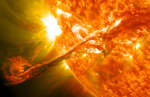 A Solar Filament Erupts
17.09.2012
What's happened to our Sun? Nothing very unusual -- it just threw a filament. At the end of last month, a long standing solar filament suddenly erupted into space producing an energetic Coronal Mass Ejection (CME).
 A Year on the Sun
26.04.2013
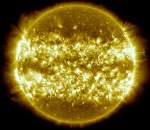
Our solar system's miasma of incandescent plasma, the Sun may look a little scary here. The picture is a composite of 25 images recorded in extreme ultraviolet light by the orbiting Solar Dynamics Observatory between April 16, 2012 and April 15, 2013.
 Rings Around the Ring Nebula
13.08.2014
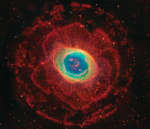
It is a familiar sight to sky enthusiasts with even a small telescope. There is much more to the Ring Nebula (M57), however, than can be seen through a small telescope. The easily visible...
 Complex Jupiter
5.06.2018
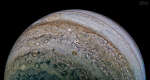
How complex is Jupiter? NASA's Juno mission to Jupiter is finding the Jovian giant to be more complicated than expected. Jupiter's magnetic field has been discovered to be much different from our Earth's simple dipole field, showing several poles embedded in a complicated network more convoluted in the north than the south.
 Touchdown on Asteroid Ryugu
12.03.2019
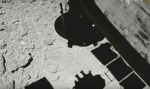
Last month, humanity bounced a robot off an asteroid. The main reason was to collect a surface sample. Despite concern over finding a safely reboundable touchdown spot, Japan's robotic Hayabusa2 spacecraft successfully touched down -- and bounced right back from -- asteroid Ryugu.
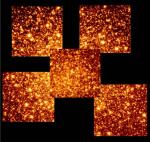 NGC 6712: Galactic Globular Cluster
25.02.1999
Following orbits which loop high above the galactic plane, globular star clusters are probably 12 to 14 billion years old - truly ancient denizens of our Milky Way Galaxy. After analyzing these new ESO/VLT images...
|
January February March April May June July August September |
|||||||||||||||||||||||||||||||||||||||||||||||||