
|
You entered: dark
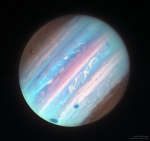 APOD: 2025 November 11 Б Jupiter in Ultraviolet from Hubble
11.11.2025
Jupiter looks a bit different in ultraviolet light. To better interpret Jupiter's cloud motions and to help NASA's robotic Juno spacecraft understand the planetary context of the small fields that it sees, the Hubble Space Telescope was being directed to regularly image the entire Jovian giant.
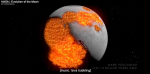 Evolution of the Moon
20.03.2012
What is the history of the Moon? The Moon was likely created from debris expelled when a Mars-sized object violently impacted the Earth about 4.5 billion years ago. Just after gravitationally condensing, as imagined above, the glowing-hot surface of the Moon cooled and cracked.
 Help Search for Interstellar Dust
25.10.2006
What caused that hole? The hole in question appears as a small dark circle on the far right. If the above image of aerogel seems dull and uninteresting, then welcome to one aspect of real world science.
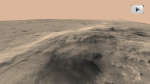 Flying Over the Columbia Hills of Mars
19.05.2008
What it would be like to fly over Mars? Combining terrain data from the orbiting Mars Global Surveyor spacecraft (now dormant) with information about the robotic Spirit rover currently rolling across Mars has resulted in a digital movie that shows what a flight over the Columbia Hills might look like.
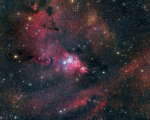 Cosmic Clouds in the Unicorn
8.02.2020
Interstellar clouds of hydrogen gas and dust abound in this gorgeous skyscape. The 3 degree wide field of view stretches through the faint but fanciful constellation Monoceros, the Unicorn. A star forming region cataloged as NGC 2264 is centered, a complex jumble of cosmic gas, dust and stars about 2,700 light-years distant.
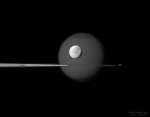 In, Through, and Beyond Saturn's Rings
4.04.2021
Four moons are visible on the featured image -- can you find them all? First -- and farthest in the background -- is Titan, the largest moon of Saturn and one of the larger moons in the Solar System. The dark feature across the top of this perpetually cloudy world is the north polar hood.
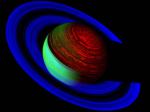 Neon Saturn
27.06.2007
If seen in the right light, Saturn glows like a neon sign. Although Saturn has comparatively little of the element neon, a composite image false-colored in three bands of infrared light highlights features of the giant ringed planet like a glowing sign.
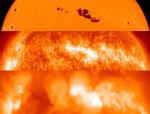 Sunspot Stack
19.04.2001
Welcome to multiwavelength astronomy! From top to bottom, these stacked panels show the largest sunspot group in a decade in visible, extreme ultraviolet, and x-ray light. All were taken on March 29, around...
 Galaxy Einstein Ring
20.04.2016
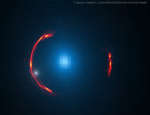
Can one galaxy hide behind another? Not in the case of SDP.81. Here the foreground galaxy, shown in blue in an image taken by the Hubble Space Telescope, acts like a huge gravitational...
 The Central Milky Way from Lagoon to Pipe
1.10.2021
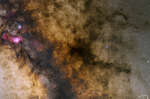
Dark markings and colorful clouds inhabit this stellar landscape. The deep and expansive view spans more than 30 full moons across crowded star fields toward the center of our Milky Way Galaxy. Cataloged in the early 20th century by astronomer E. E.
|
January February March April May June July August September |
|||||||||||||||||||||||||||||||||||||||||||||||||