
|
You entered: dark
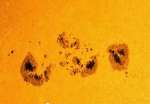 Sunspot Group AR 2339 Crosses the Sun
29.06.2015
How do sunspots evolve? Large dark sunspots -- and the active regions that contain them -- may last for weeks, but all during that time they are constantly changing. Such variations were particularly apparent...
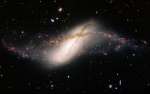 Polar Ring Galaxy NGC 660
10.11.2012
NGC 660 is featured in this cosmic snapshot, a sharp composite of broad and narrow band filter image data from the Gemini North telescope on Mauna Kea. Over 20 million light-years away and swimming within the boundaries of the constellation Pisces, NGC 660's peculiar appearance marks it as a polar ring galaxy.
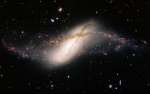 Polar Ring Galaxy NGC 660
7.11.2014
NGC 660 is featured in this cosmic snapshot, a sharp composite of broad and narrow band filter image data from the Gemini North telescope on Mauna Kea. Over 20 million light-years away and swimming within the boundaries of the constellation Pisces, NGC 660's peculiar appearance marks it as a polar ring galaxy.
 Carina Nebula Panorama from Hubble
23.06.2019
How do violent stars affect their surroundings? To help find out, astronomers created a 48-frame high-resolution, controlled-color panorama of the center of the Carina Nebula, one of the largest star forming regions on the night sky. The featured image, taken in 2007, was the most detailed image of the Carina Nebula yet taken.
 APOD: 2023 November 8 Б Perseus Galaxy Cluster from Euclid
8.11.2023
There's a new space telescope in the sky: Euclid. Equipped with two large panoramic cameras, Euclid captures light from the visible to the near-infrared. It took five hours of observing for Euclid...
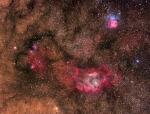 Sagittarius Triplet
4.08.2007
These three bright nebulae are often featured in telescopic tours of the constellation Sagittarius and the crowded starfields of the central Milky Way. In fact, 18th century cosmic tourist Charles Messier cataloged two of them; M8, the nebula below and right of center, and colorful M20 at the upper right.
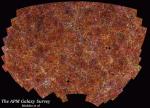 Two Million Galaxies
7.10.2007
Our universe is filled with galaxies. Galaxies -- huge conglomerations of stars, gas, dust -- and mysterious dark matter are the basic building blocks of the large-scale universe. Although distant galaxies move away from each other...
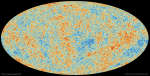 Planck Maps the Microwave Background
22.07.2018
What is our universe made of? To help find out, ESA launched the Planck satellite from 2009 to 2013 to map, in unprecedented detail, slight temperature differences on the oldest optical surface known -- the background sky when our universe first became transparent to light.
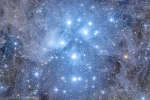 Pleiades: The Seven Sisters Star Cluster
5.12.2022
Have you ever seen the Pleiades star cluster? Even if you have, you probably have never seen it as large and clear as this. Perhaps the most famous star cluster on the sky, the bright stars of the Pleiades can be seen with the unaided eye even from the depths of a light-polluted city.
 Microwave Hotspots: The Oldest Structures Known
29.10.2000
These spots are the oldest, most distant structures known. They are seen on the above two images of the microwave sky, north and south of our galaxy's equator, based on four-year's worth of data from NASA's COsmic Background Explorer (COBE) satellite (1989-1993). The spots represent temperature variations in the early universe.
|
January February March April May June July August September |
|||||||||||||||||||||||||||||||||||||||||||||||||