
|
You entered: background
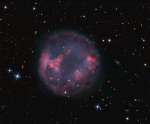 Planetary Nebula Abell 7
5.12.2013
Very faint planetary nebula Abell 7 is some 1,800 light-years distant, just south of Orion in planet Earth's skies in the constellation Lepus, The Hare. Surrounded by Milky Way stars and near...
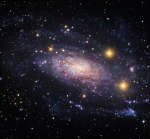 NGC 3621: Far Beyond the Local Group
24.02.2017
Far beyond the local group of galaxies lies NGC 3621, some 22 million light-years away. Found in the multi-headed southern constellation Hydra, the winding spiral arms of this gorgeous island universe are loaded with luminous blue star clusters, pinkish starforming regions, and dark dust lanes.
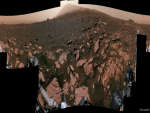 Ancient Ogunquit Beach on Mars
8.05.2017
This was once a beach -- on ancient Mars. The featured 360-degree panorama, horizontally compressed, was taken by the robotic Curiosity rover currently exploring the red planet. Named Ogunquit Beach after its terrestrial counterpart, evidence...
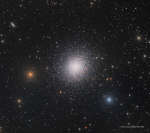 M13: The Great Globular Cluster in Hercules
19.03.2020
In 1716, English astronomer Edmond Halley noted, "This is but a little Patch, but it shews itself to the naked Eye, when the Sky is serene and the Moon absent." Of course...
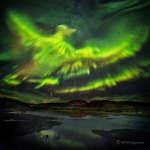 A Phoenix Aurora over Iceland
3.01.2021
All of the other aurora watchers had gone home. By 3:30 am in Iceland, on a quiet September night, much of that night's auroras had died down. Suddenly, unexpectedly, a new burst of particles streamed down from space, lighting up the Earth's atmosphere once again.
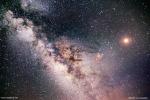 The Milky Way Behind an Eclipsed Moon
3.06.2003
What's behind the Moon? Each month, our Moon passes in front of -- and outshines -- many an interesting star field. Exceptions occur during a new Moon and during a total eclipse. In the background...
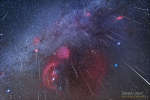 Geminids and Friends
15.12.2018
From a radiant in the constellation of the Twins, the annual Geminid meteor shower rained down on our fair planet this week. This beautiful skyscape collects about 70 of Gemini's lovely shooting stars in a digital composition made from multiple exposures.
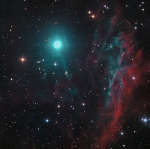 The Ghost of Jupiter s Halo
11.07.2019
Close-up images of NGC 3242 show the cast off shroud of a dying, sun-like star fancifully known as The Ghost of Jupiter nebula. But this deep and wide telescopic view also finds the seldom...
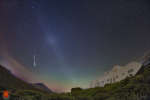 A Meteor and the Gegenschein
12.05.2021
Is the night sky darkest in the direction opposite the Sun? No. In fact, a rarely discernable faint glow known as the gegenschein (German for "counter glow") can be seen 180 degrees around from the Sun in an extremely dark sky. The gegenschein is sunlight back-scattered off small interplanetary dust particles.
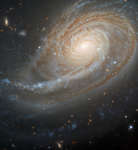 Arp 78: Peculiar Galaxy in Aries
24.03.2022
Peculiar spiral galaxy Arp 78 is found within the boundaries of the head strong constellation Aries. Some 100 million light-years beyond the stars and nebulae of our Milky Way galaxy, the island universe is over 100,000 light-years across.
|
January February March April May June July August |
||||||||||||||||||||||||||||||||||||||||||||||||||||||||