
|
You entered: background
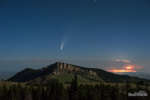 APOD: 2020 July 27 Б Comet and Lightning Beyond Bighorn Mountains
27.07.2020
Normally, Steamboat Point looks cool -- but not this cool. Every day, the iconic peak of the Bighorn Mountains is an interesting sight, in particular from US Highway 14 in Wyoming. On some rare days, the rocky vertical ridges look even more incredible when seen in front of a distant lightning storm.
 A Space Station Crosses a Busy Sun
11.04.2022
Typically, the International Space Station is visible only at night. Slowly drifting across the night sky as it orbits the Earth, the International Space Station (ISS) can be seen as a bright spot several times a year from many locations.
 APOD: 2023 December 27 Б Rainbow Aurora over Icelandic Waterfall
27.12.2023
Yes, but can your aurora do this? First, yes, auroras can look like rainbows even though they are completely different phenomena. Auroras are caused by Sun-created particles being channeled into Earth's atmosphere by Earth's magnetic field, and create colors by exciting atoms at different heights.
 APOD: 2024 May 6 Б A Total Solar Eclipse from Sliver to Ring
6.05.2024
This is how the Sun disappeared from the daytime sky last month. The featured time-lapse video was created from stills taken from Mountain View, Arkansas, USA on 2024 April 8. First, a small sliver of a normally spotted Sun went strangely dark.
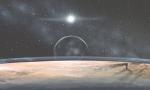 Pluto: New Horizons
18.10.2001
Pluto's horizon spans the foreground in this artist's vision, gazing sunward across that distant and still unexplored world. Titled New Horizons, the painting also depicts Pluto's companion, Charon, as a darkened, ghostly apparition with a luminous crescent against a starry background.
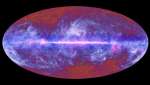 Microwave Milky Way
9.07.2010
Seen from our edge-on perspective, the Milky Way Galaxy sprawls across the middle of this false-color, all sky view. The expansive microwave map is based on 1 year's worth of data from instruments onboard the sky-surveying Planck spacecraft.
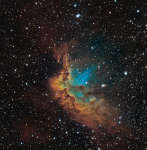 The Wizard Nebula
29.08.2014
Open star cluster NGC 7380 is still embedded in its natal cloud of interstellar gas and dust popularly known as the Wizard Nebula. Seen with foreground and background stars along the plane of our Milky Way galaxy it lies some 8,000 light-years distant, toward the constellation Cepheus.
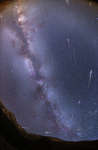 Moonless Meteors and the Milky Way
13.08.2015
Have you watched the Perseid meteor shower? Though the annual shower's predicted peak was last night, meteor activity should continue tonight (August 13/14), best enjoyed by just looking up in clear, dark skies after midnight. Of course, this year's Perseid shower has the advantage of being active near the August 14 New Moon.
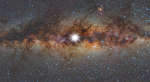 Solstice Sun and Milky Way
21.12.2017
Welcome to December's solstice, first day of winter in the north and summer for the southern hemisphere. Astronomical markers of the seasons, solstice and equinox dates are based on the Sun's place in its annual journey along the ecliptic, through planet Earth's sky.
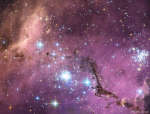 N11: Star Clouds of the LMC
29.04.2019
Massive stars, abrasive winds, mountains of dust, and energetic light sculpt one of the largest and most picturesque regions of star formation in the Local Group of Galaxies. Known as N11, the region...
|
January February March April May June July August |
||||||||||||||||||||||||||||||||||||||||||||||||||||||||