
|
You entered: Earth
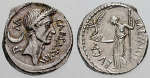 Julius Caesar and Leap Days
28.02.2020
In 46 BC Julius Caesar reformed the calendar system. Based on advice by astronomer Sosigenes of Alexandria, the Julian calendar included one leap day every four years to account for the fact that an Earth year is slightly more than 365 days long.
 APOD: 2024 May 12 Б Red Aurora over Poland
11.05.2024
Northern lights don't usually reach this far south. Magnetic chaos in the Sun's huge Active Region 3664, however, produced a surface explosion that sent a burst of electrons, protons, and more massive, charged nuclei into the Solar System.
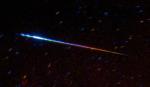 A Perseid Meteor
12.08.2000
This weekend, the annual Perseid Meteor Shower reaches its maximum. Grains of cosmic sand and gravel shed from Comet Swift-Tuttle will streak across the sky as they vaporize during entry into Earth's atmosphere. The Perseids result from the yearly
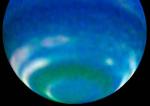 Neptune: Still Springtime After All These Years
13.06.2003
In the 1960s spring came to the southern hemisphere of Neptune, the Solar System's outermost gas giant planet. Of course, since Neptune orbits the Sun once every 165 earth-years, it's still spring for southern Neptune, where each season lasts over four decades.
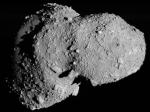 The Missing Craters of Asteroid Itokawa
20.11.2005
Where are the craters on asteroid Itokawa? No one knows. The Japanese robot probe Hayabusa recently approached the Earth-crossing asteroid and is returning pictures showing a surface unlike any other Solar System body yet photographed -- a surface possibly devoid of craters.
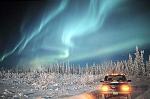 Aurora Over Alaska
3.03.1998
Higher than the highest mountain, higher than the highest airplane, lies the realm of the aurora. Aurora rarely reach below 60 kilometers, and can range up to 1000 kilometers. Aurora light results from solar electrons and protons striking molecules in the Earth's atmosphere.
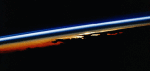 The Sun Also Rises
24.10.1998
Sunrise seen from low Earth orbit by the shuttle astronauts can be very dramatic indeed ( and the authors apologize to Hemingway for using his title!). In this breathtaking view, the Sun is just visible...
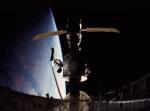 Construction of International Space Station Begins
22.02.1999
Move over Mir, here comes the International Space Station. In December 1998, the crew of Space Shuttle Endeavour started construction by joining the U.S.-built Unity node with the Russian-built Zarya module. A close look at the above IMAX(r) photograph will reveal two astronauts working on Unity.
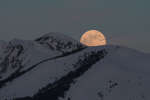 Largest Moon of 2009 Over the Alps
12.01.2009
A larger moon will not be seen this year. This past weekend, the largest full Moon of 2009 could be seen from almost any clear location on planet Earth at night. The high angular extent of the full Moon was caused by the Moon being unusually close to Earth during its full phase.
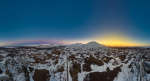 Shadowrise and Sunset
31.05.2017
The road tracking through this stunning 360 degree view crosses a remote mountain area of Jämtland, Sweden, planet Earth. A 3x8 mosaic of still images, the panorama was taken on May 3rd from a small drone 200 meters above the ground.
|
January February March April May June July August September October |
|||||||||||||||||||||||||||||||||||||||||||||||||