
|
You entered: Earth
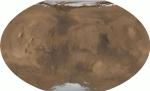 All of Mars
26.06.2001
From pole to pole, from east to west, this is all of Mars. The above picture was digitally reconstructed from over 200 million laser altimeter measurements taken by the Mars Global Surveyor spacecraft currently orbiting Mars.
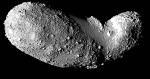 Smooth Sections on Asteroid Itokawa
22.04.2007
Why are parts of this asteroid's surface so smooth? No one is yet sure, but it may have to do with the dynamics of an asteroid that is a loose pile of rubble rather than a solid rock.
 The Clipper and the Comet
16.10.2024
NASA's Europa Clipper is now headed toward an ocean world beyond Earth. The large spacecraft is tucked into the payload fairing atop the Falcon Heavy rocket in this photo, taken at Kennedy Space Center the day before the mission's successful October 14 launch.
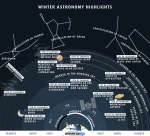 Highlights of the Winter Sky
11.12.2017
What's up in the sky this winter? The featured graphic gives a few highlights for Earth's northern hemisphere. Viewed as a clock face centered at the bottom, early winter sky events fan out toward the left, while late winter events are projected toward the right.
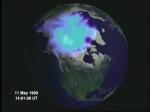 Unusual Aurora During Solar Wind Dropout
22.12.1999
On May 10, for some unknown reason, the Solar Wind virtually stopped. Normally our Sun emits a wind of between five and ten energetic particles per cubic centimeter moving outward at about 500 kilometers per second.
 Odysseus and The Dish
29.02.2024
Murriyang, the CSIROБs Parkes radio telescope points toward a nearly Full Moon in this image from New South Wales, Australia, planet Earth. Bathed in moonlight, the 64 meter dish is receiving weak radio signals from Odysseus, following the robotic lander's February 22 touch down some 300 kilometers north of the Moon's south pole.
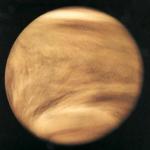 Ultraviolet Venus
7.05.1997
The forecast for Venus is cloudy, cloudy, cloudy. Although similar to the Earth in size and mass, Venus' slightly closer orbit to the Sun create for it a much thicker atmosphere and a much hotter surface. The thick atmosphere was photographed above in ultraviolet light in 1979 by the Pioneer Venus Orbiter.
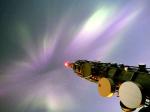 Aurora Over a Communications Tower
28.09.2004
Higher than highest communications tower, higher than highest mountain, higher than highest airplane, lies the realm of the aurora. Auroras rarely reach below 60 kilometers, and can range up to 1000 kilometers. Aurora light results from energetic electrons and protons striking molecules in the Earth's atmosphere.
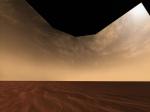 Clouds and Sand on the Horizon of Mars
17.10.2006
If you could stand on Mars -- what might you see? Like the robotic Opportunity rover rolling across the red planet, you might well see vast plains of red sand, an orange tinted sky, and wispy light clouds.
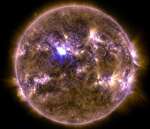 Sun with Solar Flare
13.04.2013
This week the Sun gave up its strongest solar flare so far in 2013, accompanied by a coronal mass ejection (CME) headed toward planet Earth. A false-color composite image in extreme ultraviolet light from the Solar Dynamics Observatory captures the moment, recorded on April 11 at 0711 UTC. The flash, a moderate, M6.
|
January February March April May June July August September October |
|||||||||||||||||||||||||||||||||||||||||||||||||