
|
You entered: sky
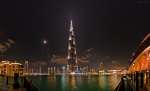 Starry Night over Dubai
16.07.2011
A starry night over the city of Dubai in the United Arab Emirates is really not so starry. In fact, the Moon is the only celestial beacon to come close to competing with city lights in this night skyscape, a situation all too familiar to urban skygazers.
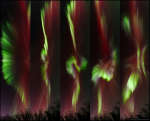 Alaska Aurora Sequence
28.12.2013
A remarkably intense auroral band flooded the northern night with shimmering colors on December 7. The stunning sequence captured here was made with a camera fixed to a tripod under cold, clear skies near Ester, just outside of Fairbanks, Alaska.
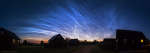 Veins of Heaven
31.07.2014
Transfusing sunlight through a a still dark sky, this exceptional display of noctilucent clouds was captured earlier this month above the island of Gotland, Sweden. From the edge of space, about 80 kilometers above...
 Comet Pons-Brooks at Night
4.04.2024
In dark evening skies over June Lake, northern hemisphere, planet Earth, Comet 12P/Pons-Brooks stood just above the western horizon on March 30. Its twisted turbulent ion tail and diffuse greenish coma are captured in this two degree wide telescopic field of view along with bright yellowish star Hamal also known as Alpha Arietis.
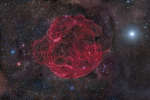 Simeis 147: Supernova Remnant
9.10.2012
It's easy to get lost following the intricate filaments in this detailed mosaic image of faint supernova remnant Simeis 147 (S147). Also cataloged as Sh2-240, it covers nearly 3 degrees or 6 full moons on the sky. That's about 150 light-years at the stellar debris cloud's estimated distance of 3,000 light-years.
 Moon Over Shiraz
13.11.2004
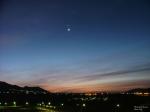
Early morning risers around the world have enjoyed the sight of bright planets in this week's predawn skies - further enhanced by the celestial spectacle of the waning crescent Moon. From some locations the Moon was seen to pass in front of Jupiter or Venus, a lunar occultation.
 Comet Between Fireworks and Lightning
5.07.2008
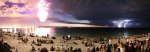
Sometimes the sky itself is the best show in town. Last January, people from Perth, Australia gathered on a local beach to watch a sky light up with delights near and far. Nearby, fireworks exploded as part of Australia Day celebrations. On the far right, lightning from a thunderstorm flashed in the distance.
 Geminid Fireball over Mount Balang
16.12.2014
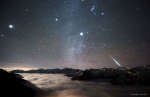
This was a sky to remember. While viewing the Geminids meteor shower a few days ago, a bright fireball was captured over Mt. Balang, China with particularly picturesque surroundings. In the foreground, a sea of light clouds slowly floated between dark mountain peaks.
 Auroras and Star Trails over Iceland
18.05.2015
It was one of the quietest nights of aurora in weeks. Even so, in northern- Iceland during last November, faint auroras lit up the sky every clear night. The featured 360-degree panorama is the digital fusion of four wide-angle cameras each simultaneously taking 101 shots over 42 minutes.
 Star Trails Over Oregon
9.09.2009
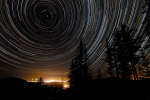
As the Earth spins on its axis, the sky seems to rotate around us. This motion, called diurnal motion, produces the beautiful concentric trails traced by stars during time exposures. Partial-circle star trails are pictured above over Grants Pass, Oregon, USA last month.
|
January February March April May June July August September October |
|||||||||||||||||||||||||||||||||||||||||||||||||