
|
You entered: star system
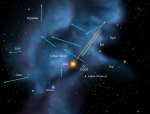 The Local Fluff
24.09.2013
The stars are not alone. In the disk of our Milky Way Galaxy about 10 percent of visible matter is in the form of gas, called the interstellar medium (ISM). The ISM is not uniform, and shows patchiness even near our Sun.
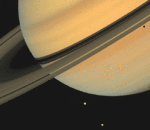 Saturn with Moons Tethys and Dione
31.05.1997
Saturn and two of its larger moons - Tethys and Dione - were photographed by the Voyager 1 spacecraft which flew by the planet in November of 1980. This picture gives an indication of Saturn's extensive ring system, which can be seen casting a shadow on the planet, as does Tethys.
 Saturn with Moons Tethys and Dione
18.03.1996
Saturn and two of its larger moons - Tethys and Dione - were photographed by the Voyager 1 spacecraft which flew by the planet in November of 1980. This picture gives an indication of Saturn's extensive ring system, which can be seen casting a shadow on the planet, as does Tethys.
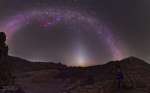 Zodiacal Light Vs. Milky Way
20.03.2010
Ghostly Zodiacal light, featured near the center of this remarkable panorama, is produced as sunlight is scattered by dust in the Solar System's ecliptic plane. In the weeks surrounding the March equinox (today...
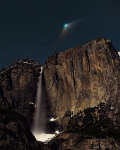 APOD: 2023 February 21 Б Comet ZTF over Yosemite Falls
21.02.2023
They are both falling. The water in Yosemite Falls, California, USA, is falling toward the Earth. Comet ZTF is falling toward the Sun. This double cosmic cascade was captured late last month as fading Comet C/2022 E3 (ZTF) had just passed its closest to planet Earth. The orange star just over the falls is Kochab.
 International Space Station Trail
14.12.2000
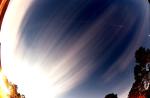
Still under construction, the International Space Station is literally becoming one of the brightest, fastest moving stars in the heavens. Despite illuminated clouds and bright light from a nearly full moon (lower left), this...
 PanSTARRS: The Anti Tail Comet
29.06.2013
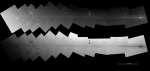
Once known as Earth's sunset comet, PanSTARRS (C/2011 L4) is up all night now, but only for northern hemisphere skygazers. Telescopes are required to track its progress as it fades and heads for the outer solar system.
 APOD: 2025 March 12 Б NGC 772: The Fiddlehead Galaxy
12.03.2025
Why does this galaxy look like a curly vegetable? The Fiddlehead spiral galaxy likely gets its distorted spiral appearance from a gravitational interaction with its close-by elliptical companion NGC 770, seen just below. Cataloged...
 APOD: 2025 July 17 Б 3I/ATLAS
17.07.2025
Discovered on July 1 with the NASA-funded ATLAS (Asteroid Terrestrial-impact Last Alert, System) survey telescope in Rio Hurtado, Chile, 3I/ATLAS is so designated as the third known interstellar object to pass through our Solar System It follows 1I/йOumuamua in 2017 and the comet 2I/Borisov in 2019.
 Too Close to a Black Hole
5.01.1997
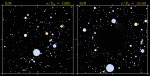
What would you see if you went right up to a black hole? Above are two computer generated pictures highlighting how strange things would look. On the left is a normal star field containing the constellation Orion. Notice the three stars of nearly equal brightness that make up Orion's Belt.
|
January February March April May June July August September |
|||||||||||||||||||||||||||||||||||||||||||||||||