
|
You entered: Sun
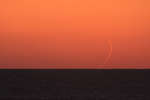 Moonset from Taiwan
14.08.2013
It took three worlds to create this simple image. The first world was the Earth, which was quite prominent. The dividing line running horizontally below the middle separates sea from sky. On this part of the Earth, it was almost nighttime. The second world was the Moon, which was almost invisible.
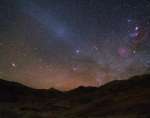 The Gegenschein Over Chile
14.01.2014
Is the night sky darkest in the direction opposite the Sun? No. In fact, a rarely discernable faint glow known as the gegenschein (German for "counter glow") can be seen 180 degrees around from the Sun in an extremely dark sky. The gegenschein is sunlight back-scattered off small interplanetary dust particles.
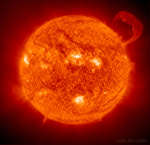 A Solar Prominence from SOHO
30.01.2022
How can gas float above the Sun? Twisted magnetic fields arching from the solar surface can trap ionized gas, suspending it in huge looping structures. These majestic plasma arches are seen as prominences above the solar limb.
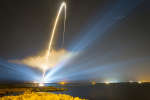 Parker vs Perseid
16.08.2018
The brief flash of a bright Perseid meteor streaks across the upper right in this composited series of exposures made early Sunday morning near the peak of the annual Perseid meteor shower.
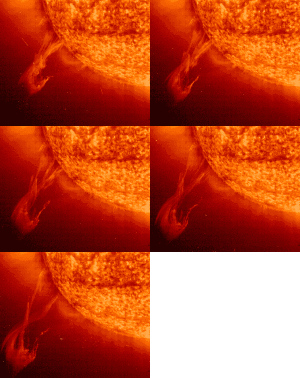 A Twisted Solar Eruptive Prominence
23.02.2003
A huge eruptive prominence is seen moving out from our Sun in this condensed half-hour time-lapse sequence. Ten Earths could easily fit in the "claw" of this seemingly solar monster. This large prominence, though, is significant not only for its size, but its shape.
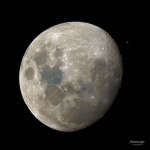 Saturn Behind the Moon
14.08.2019
What's that next to the Moon? Saturn. In its monthly trip around the Earth -- and hence Earth's sky -- our Moon passed nearly in front of Sun-orbiting Saturn earlier this week. Actually the Moon passed directly in front of Saturn from the viewpoints of a wide swath of Earth's Southern Hemisphere.
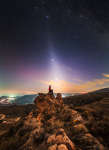 APOD: 2023 February 27 Б Zodiacal Ray with Venus and Jupiter
27.02.2023
What's causing that unusual ray of light extending from the horizon? Dust orbiting the Sun. At certain times of the year, a band of sun-reflecting dust from the inner Solar System appears prominently after sunset or before sunrise and is called zodiacal light.
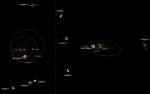 Farther Along
6.05.2011
What is humanity's most distant spacecraft? Launched in 1977, Voyager 1 now holds that distinction at 17.5 billion kilometers from the Sun. That corresponds to 16 light-hours or 117 Astronomical Units (AU). This...
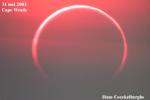 Ring of Fire from Cape Wrath
5.06.2003
If the Moon's apparent diameter is not quite large enough to cover the Sun during a solar eclipse, an annular eclipse can be the result -- a spectacle of silhouetted Moon surrounded by a solar "ring of fire".
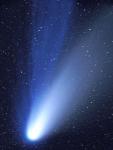 The Dust and Ion Tales of Comet Hale-Bopp
22.05.2005
In 1997, Comet Hale-Bopp's intrinsic brightness exceeded any comet since 1811. Since it peaked on the other side of the Earth's orbit, however, the comet appeared only brighter than any comet in two decades. Visible above are the two tails shed by Comet Hale-Bopp.
|
January February March April May June July August September |
|||||||||||||||||||||||||||||||||||||||||||||||||