
|
You entered: satellite
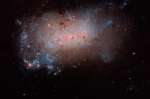 NGC 4449: Close up of a Small Galaxy
14.07.2017
(xxxedit and linkxxx) Grand spiral galaxies often seem to get all the glory. Their young, blue star clusters and pink star forming regions along sweeping spiral arms are guaranteed to attract attention. But small irregular galaxies form stars too, like NGC 4449, about 12 million light-years distant.
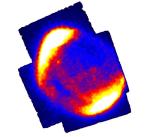 SN 1006: Pieces of the Cosmic Ray Puzzle
2.12.2000
Research balloon flights conducted in 1912 by Austrian physicist Victor Hess revealed that the Earth was constantly bombarded by high energy radiation from space - which came to be called "Cosmic Rays". What are Cosmic Rays and where do they come from?
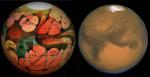 Mars Then and Now
12.11.2003
Does Mars have canals? A hot debate topic of the late 1800s, several prominent astronomers including Percival Lowell not only claimed to see an extensive system of long straight canals on Mars, but used them to indicate that intelligent life exists there.
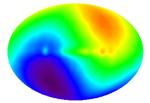 CMBR Dipole: Speeding Through the Universe
8.10.2006
Our Earth is not at rest. The Earth moves around the Sun. The Sun orbits the center of the Milky Way Galaxy. The Milky Way Galaxy orbits in the Local Group of Galaxies. The Local Group falls toward the Virgo Cluster of Galaxies.
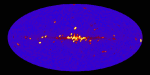 The X-Ray Sky
2.01.1996
What if you could see X-rays? If you could, the night sky would be a strange and unfamiliar place. X-rays are about 1,000 times more energetic than visible light photons and are produced in violent and high temperature astrophysical environments.
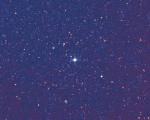 A Close Encounter of the Stellar Kind
26.06.1997
The unassuming star centered in this sky view will one day be our next door stellar neighbor. The faint 9th magnitude red dwarf currently 63 light-years away in the constellation Ophiucus was recently discovered to be on a course toward our Solar System.
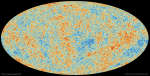 Planck Maps the Microwave Background
22.07.2018
What is our universe made of? To help find out, ESA launched the Planck satellite from 2009 to 2013 to map, in unprecedented detail, slight temperature differences on the oldest optical surface known -- the background sky when our universe first became transparent to light.
 Microwave Hotspots: The Oldest Structures Known
29.10.2000
These spots are the oldest, most distant structures known. They are seen on the above two images of the microwave sky, north and south of our galaxy's equator, based on four-year's worth of data from NASA's COsmic Background Explorer (COBE) satellite (1989-1993). The spots represent temperature variations in the early universe.
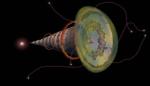 Cosmic Rays and Supernova Dust
18.06.1998
Cosmic Rays are celestial high energy particles traveling at nearly the speed of light, which constantly bombard the Earth. Discovered during high altitude balloon flights in 1912 their source has been a long standing mystery.
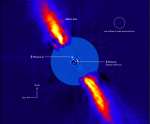 Probably a Planet for Beta Pic
28.11.2008
A mere 50 light-years away, young star Beta Pictoris became one of the most important stars in the sky in the early 1980s. Satellite and ground-based telescopic observations revealed the presence of a surrounding...
|
January February |
|||||||||||||||||||||||||||||||||||||||||||||||||