
|
You entered: star system
 APOD: 2025 September 25 Б Saturn Opposite the Sun
24.09.2025
This year Saturn was at opposition on September 21, opposite the Sun in planet Earth's sky. At its closest to Earth, Saturn was also at its brightest of the year, rising as the Sun set and shining above the horizon all night long among the fainter stars of the constellation Pisces.
 Cold Comet Halley
3.10.2003
While this may not be the most esthetic image of Comet Halley that you have ever seen, it is likely the most unique. The tiny cluster of pixels circled is the famous comet along...
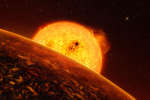 CoRoT Satellite Discovers Rocky Planet
23.09.2009
How similar is exoplanet CoRoT-7b to Earth? The newly discovered extra-solar planet is the closest physical match yet, with a mass about five Earths and a radius of about 1.7 Earths. Also, the home star to CoRoT-7b, although 500 light years distant, is very similar to our Sun.
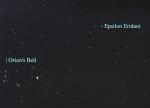 Nearby Star Epsilon Eridani Has a Planet
7.08.2000
A planet has been found orbiting a Sun-like star only 10 light-years away. No direct picture of the planet was taken - the planet was discovered by the gravitational wobble it created on its parent star, Epsilon Eridani. The discovery marks the closest Sun-like star yet found to house an extra-solar planet.
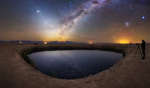 Laguna Starry Sky
26.01.2018
Staring toward the heavens, one of the many lagunas in the Atacama Desert salt flat calmly reflects a starry night sky near San Pedro de Atacama, Chile, planet Earth. Cosmic rifts of dust, star clouds, and nebulae of the central Milky Way galaxy are rising in the east, beyond a volcanic horizon.
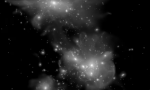 Simulation TNG50: A Galaxy Cluster Forms
25.02.2019
How do clusters of galaxies form? Since our universe moves too slowly to watch, faster-moving computer simulations are created to help find out. A recent effort is TNG50 from IllustrisTNG, an upgrade of the famous Illustris Simulation.
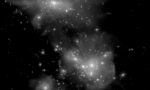 Simulation TNG50: A Galaxy Cluster Forms
28.05.2022
How do clusters of galaxies form? Since our universe moves too slowly to watch, faster-moving computer simulations are created to help find out. A recent effort is TNG50 from IllustrisTNG, an upgrade of the famous Illustris Simulation.
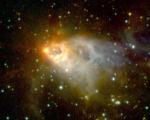 AFGL 2591: A Massive Star Acts Up
29.08.2001
Young star AFGL 2591 is putting on a show. The massive star is expelling outer layers of dust-laced gas as gravity pulls inner material toward the surface. AFGL 2591 is estimated to be about...
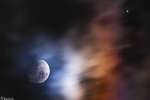 APOD: 2020 September 2 Б Jupiter and the Moons
1.09.2020
How many moons do you see? Many people would say one, referring to the Earth's Moon, prominent on the lower left. But take a closer look at the object on the upper right.
 The Comet Hartley 2 Cruise
7.10.2011
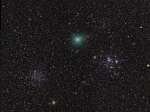
Early last November, small but active Comet Hartley 2 (103/P Hartley) became the fifth comet imaged close-up by a spacecraft from planet Earth. Still cruising through the solar system with a 6 year orbital period, Hartley 2 is is making astronomical headlines again, though.
|
January February March April May June July August |
||||||||||||||||||||||||||||||||||||||||||||||||||||||||