
|
You entered: distance
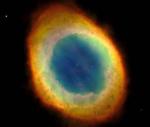 The Ring
7.01.1999
Except for the Rings of Saturn, The Ring Nebula (M57) is probably the most famous celestial band. This planetary nebula's simple, graceful appearance is thought to be due to perspective -- our view from planet Earth looking straight into what is actually a barrel-shaped cloud of gas shrugged off by a dying central star.
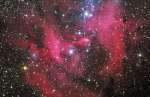 IC 2948: The Running Chicken Nebula
18.04.2008
Bright nebulae abound in and around the expansive southern constellation of Centaurus. This one, cataloged as IC 2948 is near the star Lambda Centauri and not far on the sky from the better known Eta Carinae Nebula.
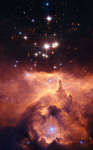 Massive Stars in Open Cluster Pismis 24
26.10.2008
How massive can a normal star be? Estimates made from distance, brightness and standard solar models had given one star in the open cluster Pismis 24 over 200 times the mass of our Sun, making it a record holder. This star is the brightest object located just above the gas front in the above image.
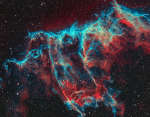 A Spectre in the Eastern Veil
1.11.2008
Menacing flying forms and garish colors are a mark of the Halloween season. They also stand out in this cosmic close-up of the eastern Veil Nebula. The Veil Nebula itself is a large supernova remnant, the expanding debris cloud from the death explosion of a massive star.
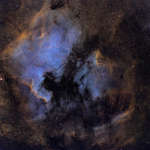 North America and the Pelican
18.12.2010
Here lie familiar shapes in unfamiliar locations. On the left is an emission nebula cataloged as NGC 7000, famous partly because it resembles our fair planet's continent of North America. The emission region to the right of the North America Nebula is IC 5070, also known for its suggestive outlines as the Pelican Nebula.
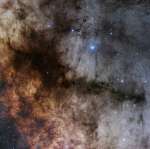 The Pipe Nebula
23.11.2012
East of Antares, dark markings sprawl through crowded star fields toward the center of our Milky Way Galaxy. Cataloged in the early 20th century by astronomer E. E. Barnard, the obscuring interstellar dust clouds include B59, B72, B77 and B78, seen in silhouette against the starry background.
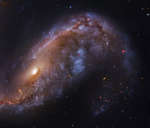 NGC 2442: Galaxy in Volans
17.08.2017
Distorted galaxy NGC 2442 can be found in the southern constellation of the flying fish, (Piscis) Volans. Located about 50 million light-years away, the galaxy's two spiral arms extending from a pronounced central bar have a hook-like appearance in wide-field images.
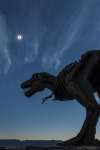 Eclipsosaurus Rex
7.10.2017
We live in an era where total solar eclipses are possible because at times the apparent size of the Moon can just cover the disk of the Sun. But the Moon is slowly moving away from planet Earth. Its distance is measured to increase about 1.5 inches (3.8 centimeters) per year due to tidal friction.
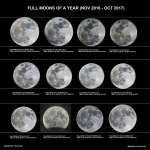 A Year of Full Moons
5.11.2017
Do all full moons look the same? No. To see the slight differences, consider this grid of twelve full moons. From upper left to lower right, the images represent every lunation from 2016 November through 2017 October, as imaged from Pakistan.
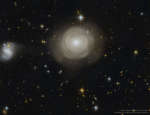 Shells of Stars in Elliptical Galaxy PGC 42871
29.10.2018
How do galaxies grow? To help find out, the Hubble Space Telescope was deployed to image the unusual elliptical galaxy PGC 42871. How this galaxy came to be surrounded by numerous shells of stars may give clues about how it evolved.
|
January February March April May |
|||||||||||||||||||||||||||||||||||||||||||||||||