
|
You entered: Coma
 A Brighter Comet LINEAR
25.06.2001
Brighter than ever expected, comet LINEAR -- you know, the one designated C/2001 A2 -- is a sight to see in southern skies. This comet LINEAR first brightened impressively in late March as its active nucleus began to fragment, prompting some speculation that the comet might soon break up completely.
 The Long Tails of Comet NEOWISE
16.07.2020
This Comet NEOWISE (C/2020 F3) now sweeps through our fair planet's northern skies. Its long tails stretch across this deep skyview from Suchy Vrch, Czech Republic. Recorded on the night of July 13/14...
 The Comet Hartley 2 Cruise
7.10.2011
Early last November, small but active Comet Hartley 2 (103/P Hartley) became the fifth comet imaged close-up by a spacecraft from planet Earth. Still cruising through the solar system with a 6 year orbital period, Hartley 2 is is making astronomical headlines again, though.
 Comet Holmes from the Hubble Space Telescope
28.11.2007
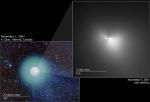
Why did Comet Holmes brighten? The unexpectedly bright Comet 17P/Holmes continues to grace northern skies as a naked-eye addition to the constellation Perseus. Any northern sky enthusiast with a dark sky, a bright curiosity, and a recent sky map should still be able to locate the comet in a few minutes.
 Comet Lovejoy: Sungrazing Survivor
17.12.2011
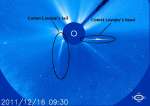
Like most other sungrazing comets, Comet Lovejoy (C/2011 W3) was not expected to survive its close encounter with the Sun. But it did. This image from a coronograph onboard the sun-staring SOHO spacecraft identifies the still inbound remnants of the tail, with the brilliant head or coma emerging from the solar glare on December 16.
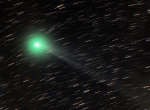 Comet Lemmon near the South Celestial Pole
7.02.2013
Currently sweeping through southern skies, Comet Lemmon (C/2012 F6) was named for its discovery last year as part of the Mount Lemmon (Arizona) Survey. Brighter than expected but still just below naked-eye visibility, Comet Lemmon sports a stunning lime green coma and faint divided tail in this telescopic image from February 4.
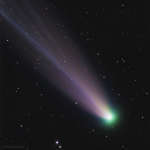 Comet Leonard Closeup from Australia
12.01.2022
What does Comet Leonard look like up close? Although we can't go there, imaging the comet's coma and inner tails through a small telescope gives us a good idea. As the name...
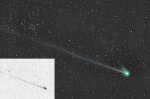 Comet McNaught Passes NGC 1245
17.06.2010
Of the many comets named for discoverer Robert McNaught, the one cataloged as C/2009 R1 is gracing dawn skies for northern hemisphere observers this month. Seen here on June 13th from southern New Mexico, this Comet McNaught's long ion tail sweeps across the telescopic field of view (a negative image is inset).
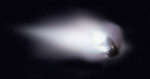 Comet Halleys Nucleus: An Orbiting Iceberg
4.01.2010
What does a comet nucleus look like? Formed from the primordial stuff of the Solar System, comet nuclei were thought to resemble very dirty icebergs. But ground-based telescopes revealed only the surrounding cloud of gas and dust of active comets nearing the Sun, clearly resolving only the comet's coma, and the characteristic cometary tails.
 McNaught Now Brightest Comet in Decades
9.01.2007
The brightest comet in decades is unexpectedly now visible. The most optimistic predictions have Comet McNaught (C/2006 P1) shortly becoming one of the brightest comets of the past century. For the next few days...
|
January February March April May June July August September October |
|||||||||||||||||||||||||||||||||||||||||||||||||