
|
You entered: Coma
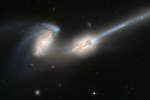 NGC 4676: When Mice Collide
24.02.2008
These two mighty galaxies are pulling each other apart. Known as " The Mice" because they have such long tails, each spiral galaxy has likely already passed through the other. They will probably collide again and again until they coalesce.
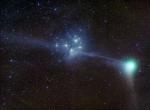 Machholz Meets the Pleiades
11.01.2005
Sweeping northward in planet Earth's sky, comet Machholz extended its long ion tail with the Pleiades star cluster in the background on January 7th. This stunning view, recorded with a telephoto lens in skies over Oberjoch, Bavaria, Germany, emphasizes faint, complex tail structures and the scene's lovely blue and green colors.
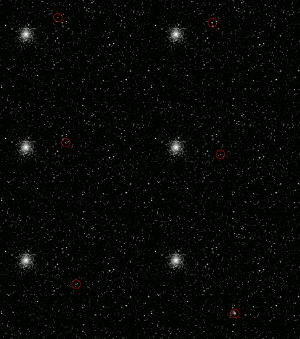 Rosetta s Target Comet
23.05.2014
The Rosetta spacecraft captured this remarkable series of 9 frames between March 27 and May 4, as it closed from 5 million to 2 million kilometers of its target comet. Cruising along...
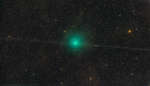 APOD: 2026 July 17 Б The Dust Trail of Comet Tempel 2
17.07.2026
Comet 10P/Tempel 2 orbits the Sun once every 5.4 years. Currently visible in binoculars or small telescopes toward the constellation Capricornus, the periodic comet is captured in this sharp telescopic image from July 11 sporting a bright nuclear region and pretty greenish coma.
 Close Comet and the Milky Way
25.03.2016
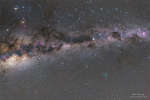
Comet 252P/Linear's lovely greenish coma is easy to spot in this expansive southern skyscape. Visible to the naked eye from the dark site near Flinders, Victoria, Australia, the comet appears tailless. Still, its surprisingly bright coma spans about 1 degree, posed here below the nebulae, stars, and dark rifts of the Milky Way.
 APOD: 2023 February 13 Б Comet ZTF and Mars
13.02.2023
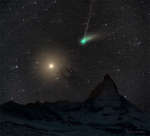
No, Comet ZTF is not going to hit Mars. Nicknamed the Green Comet for its bright green coma, C/2022 E3 (ZTF) did, however, pass almost in front of the much-more distant planet a few days ago, very near in time to when the featured picture was taken.
 Most of Comet Tsuchinshan ATLAS
18.10.2024
On October 14 it was hard to capture a full view of Comet C/2023 A3 Tsuchinshan-ATLAS. Taken after the comet's closest approach to our fair planet, this evening skyview almost does though. With...
 Comet 46P Wirtanen
15.11.2018
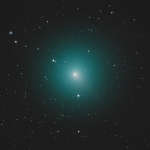
Periodic Comet 46P/Wirtanen is now the brightest comet in the night sky, but too faint to be seen by eye. From dark sky sites it could just become naked-eye visible though, as it's 5.4 year long looping orbit takes it closest to Earth and the Sun in mid December.
 Comet Lulin Tails
7.02.2009
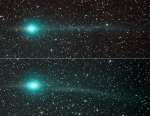
Sweeping through the inner solar system, Comet Lulin is easily visible in both northern and southern hemispheres with binoculars or a small telescope. Recent changes in Lulin's lovely greenish coma and tails are featured in this two panel comparison of images taken on January 31st (top) and February 4th.
 Messier 6 and Comet Siding Spring
17.10.2014
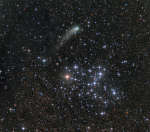
This looks like a near miss but the greenish coma and tail of Comet Siding Spring (C/2013 A1) are really 2,000 light-years or so away from the stars of open cluster Messier 6. They do appear close together though, along the same line-of-sight in this gorgeous October 9th skyscape toward the constellation Scorpius.
|
January February March April May June July August September |
|||||||||||||||||||||||||||||||||||||||||||||||||