
|
You entered: Sun
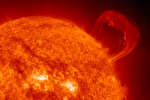 A Solar Prominence from SOHO
31.05.2009
How can gas float above the Sun? Twisted magnetic fields arching from the solar surface can trap ionized gas, suspending it in huge looping structures. These majestic plasma arches are seen as prominences above the solar limb.
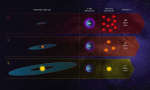 Goldilocks Zones and Stars
31.01.2020
The Goldilocks zone is the habitable zone around a star where it's not too hot and not too cold for liquid water to exist on the surface of orbiting planets. This intriguing infographic...
 APOD: 2023 December 3 Б Moon Setting Behind Teide Volcano
3.12.2023
These people are not in danger. What is coming down from the left is just the Moon, far in the distance. Luna appears so large here because she is being photographed through a telescopic lens.
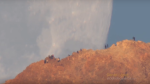 APOD: 2026 May 11 Б Moon Setting Behind Teide Volcano
11.05.2026
These people are not in danger. What is coming down from the left is just the Moon, far in the distance. Luna appears so large here because she is being photographed through a telescopic lens.
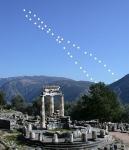 Sunrise Analemma
20.03.2003
Astronomically speaking, at the Equinox on March 21, 01:00 UT (March 20, 8:00 PM ET) the season changes. For this Equinox the Sun rises due east as it crosses the celestial equator heading north. In celebration, consider this spectacular sunrise analemma!
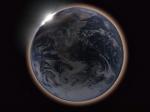 Solar Eclipse from the Moon
2.03.2007
Parts of Saturday's (March 3) lunar eclipse will be widely visible. For example, skywatchers in Europe, Africa, and western Asia will be able to see the entire spectacle of the Moon gliding through Earth's shadow, but in eastern North America the Moon will rise already in its total eclipse phase.
 APOD: 2023 May 16 Б Total Eclipse: The Big Corona
16.05.2023
Most photographs don't adequately portray the magnificence of the Sun's corona. Seeing the corona first-hand during a total solar eclipse is unparalleled. The human eye can adapt to see coronal features and extent that average cameras usually cannot. Welcome, however, to the digital age.
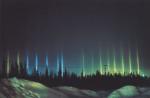 Colorful Light Pillars
2.09.2002
How can an aurora appear so near the ground? Pictured above are not aurora but nearby light pillars, a local phenomenon that can appear as a distant one. In most places on Earth...
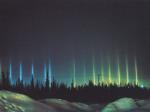 Colorful Light Pillars
5.03.2006
How can an aurora appear so near the ground? Pictured above are not aurora but nearby light pillars, a local phenomenon that can appear as a distant one. In most places on Earth...
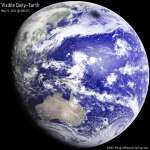 Looking Back at an Eclipsed Earth
30.05.2012
What's that dark spot on planet Earth? It's the shadow of the Moon. The above image of Earth was taken last week by MTSAT during an annular eclipse of the Sun. The dark spot appears quite unusual as clouds are white and the oceans are blue in this color corrected image.
|
January February March April May June July August September |
|||||||||||||||||||||||||||||||||||||||||||||||||