
|
You entered: time
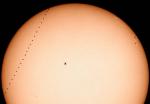 A Mercury Transit Sequence
27.05.2003
Earlier this month, the planet Mercury crossed the face of the Sun, as seen from Earth. Because the plane of Mercury's orbit is not exactly coincident with the plane of Earth's orbit, Mercury usually appears to pass over or under the Sun.
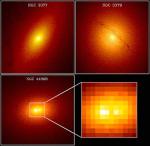 Black Holes and Galactic Centers
14.01.1997
Do all galaxies have black holes at their centers? Although not even a single galaxy has yet been proven to have a central black hole, the list of candidates has increased yet again. Recent...
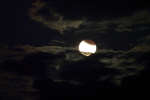 A Partial Lunar Eclipse
28.06.2010
What's happened to the Moon? This past weekend, once again, part of the Moon moved through the Earth's shadow. This happens about once or twice a year, on the average, but not each month since the Moon's orbit around the Earth is slightly tilted.
 Milky Way Above Easter Island
18.06.2012
Why were the statues on Easter Island built? No one is sure. What is sure is that over 800 large stone statues exist there. The Easter Island statues, stand, on the average, over twice as tall as a person and have over 200 times as much mass.
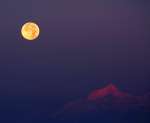 Hunter s Moon over the Alps
3.11.2012
A Full Moonset can be a dramatic celestial sight, and Full Moons can have many names. Late October's Full Moon, the second Full Moon after the northern hemisphere autumnal equinox, has been traditionally called the Hunter's Moon.
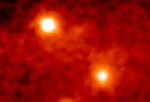 Gamma Ray Crab, Geminga
24.06.1995
What if you could "see" in gamma-rays? If you could, these two spinning neutron stars or pulsars would be among the brightest objects in the sky. This computer processed image shows the Crab Nebula pulsar (below and right of center) and the Geminga pulsar (above and left of center) in the "light" of gamma-rays.
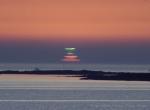 A Green Flash from the Sun
10.11.2002
Many think it is just a myth. Others think it is true but its cause isn't known. Adventurers pride themselves on having seen it. It's a green flash from the Sun. The truth is the green flash does exist and its cause is well understood.
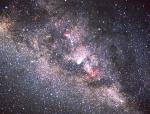 Comet Halley and the Milky Way
3.10.1997
Comet Halley was photographed superposed in front of the disk of our Milky Way Galaxy in 1986 by the Kuiper Airborne Observatory. Comet Halley is the bright white streak near this photograph's center. Comet Halley is the most famous comet in history, and returns to the inner Solar System every 76 years.
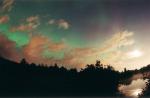 Aurora Over Clouds
10.09.2003
Aurorae usually occur high above the clouds. The auroral glow is created when fast-moving particles ejected from the Sun impact air molecules high in the Earth's atmosphere. An oxygen molecule, for example, will glow in a green light when reacquiring an electron lost during a collision with a solar particle.
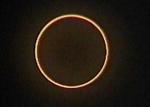 An Annular Eclipse of the Sun
24.08.1998
An annular eclipse of the Sun was visible in parts of the Eastern Hemisphere on Saturday. The above picture was taken at that time by a video camera in Mersing on the East Coast of Malaysia and emailed to APOD yesterday from an internet cafe in Kuala Lumpur.
|
January February March April May June July August September |
|||||||||||||||||||||||||||||||||||||||||||||||||