
|
You entered: image
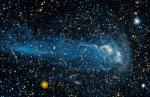 The Tail of a Wonderful Star
17.08.2007
To seventeenth century astronomers, Omicron Ceti or Mira was known as a wonderful star, a star whose brightness could change dramatically in the course of about 11 months. Mira is now seen as the archetype of an entire class of long-period variable stars.
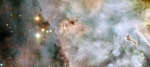 Massive Stars Resolved in the Carina Nebula
1.12.2008
How massive can stars be? Big, hefty stars live short violent lives that can profoundly affect their environments. Isolating a massive star can be problematic, however, since what seems to be a single bright star might actually turn out to be several stars close together.
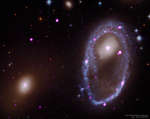 Cosmic Collision Forges Galactic Ring
17.09.2018
How could a galaxy become shaped like a ring? The rim of the blue galaxy pictured on the right is an immense ring-like structure 150,000 light years in diameter composed of newly formed, extremely bright, massive stars.
 A Total Lunar Eclipse Corona
9.06.2021
This moon appears multiply strange. This moon was a full moon, specificallyбcalled a Flower Moon at this time of the year. But that didn't make it strange -- full moons occur once a month (moon-th).
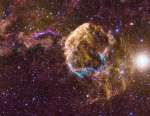 Sibling Supernova Remnants
2.07.2026
What happens when one of the stars in a binary goes supernova? This image combines visible (yellow), ultraviolet (purple) and infrared light (cyan, red and orange) to show two supernova remnants and their surrounding environment, about 6,000 light-years away. The younger one is the well-known Jellyfish Nebula in the center (mostly in yellow).
 EUVE Sky Map
31.01.2002
The stars beyond the Sun and the distant galaxies should be undetectable at extreme ultraviolet wavelengths. At least that was the conventional wisdom when it was first realized that the space between the stars is filled with hydrogen, a strong absorber of extreme ultraviolet light.
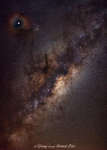
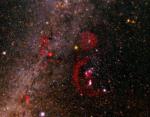 Canaries Sky
10.04.1999
This gorgeous view of stars, nebulae, and the Milky Way comes from the dark night sky above the lovely island of La Palma in the Canaries archipelago. The picture was made by a group...
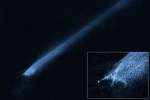 P2010 A2: Unusual Asteroid Tail Implies Powerful Collision
3.02.2010
What is this strange object? First discovered on ground based LINEAR images on January 6, the object appeared unusual enough to investigate further with the Hubble Space Telescope last week. Pictured above, what Hubble saw indicates that P/2010 A2 is unlike any object ever seen before.
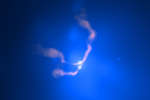 Binary Black Hole in 3C 75
14.03.2010
What's happening in the middle of this massive galaxy? There, two bright sources at the center of this composite x-ray (blue)/radio (pink) image are thought to be co-orbiting supermassive black holes powering the giant radio source 3C 75.
 Zodiacal Light Panorama
5.04.2012
Sweeping from the eastern to western horizon, this 360 degree panorama follows the band of zodiacal light along the solar system's ecliptic plane. Dust scattering sunlight produces the faint zodiacal glow that spans...
|
January February March April May June July August September |
|||||||||||||||||||||||||||||||||||||||||||||||||