
|
You entered: image
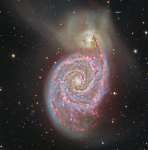 Hydrogen in M51
11.06.2010
Perhaps the original spiral nebula, M51 is a large galaxy, over 60,000 light-years across, with a readily apparent spiral structure. Also cataloged as NGC 5194, M51 is a part of a well-known interacting galaxy pair, its spiral arms and dust lanes clearly sweeping in front of companion galaxy NGC 5195 (top).
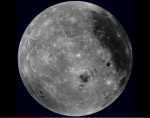 Rotating Moon from LRO
16.09.2013
No one, presently, sees the Moon rotate like this. That's because the Earth's moon is tidally locked to the Earth, showing us only one side. Given modern digital technology, however, combined with many detailed images returned by the Lunar Reconnaissance Orbiter (LRO), a high resolution virtual Moon rotation movie has now been composed.
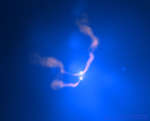 Two Black Holes Dancing in 3C 75
22.10.2017
What's happening at the center of active galaxy 3C 75? The two bright sources at the center of this composite x-ray (blue)/ radio (pink) image are co-orbiting supermassive black holes powering the giant radio source 3C 75.
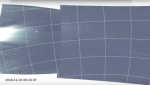 Looking Sideways from the Parker Solar Probe
9.12.2019
Everybody sees the Sun. Nobody's been there. Starting in 2018 though, NASA launched the robotic Parker Solar Probe (PSP) to investigate regions near to the Sun for the first time. The PSP's looping orbit brings it yet closer to the Sun each time around -- every few months.
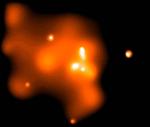 X-Rays From The Galactic Center
20.01.2000
Exploring quasars and active galaxies in the distant universe, astronomers have come to believe that most galaxies have massive black holes at their centers. Swirling stars and a strong, variable radio source offer convincing evidence that even our own Milky Way galaxy's center harbors such a bizarre object, a mere 30,000 light-years away.
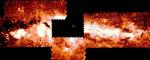 Galactic Centre Starscape
29.06.2000
Thirty thousand light-years distant, beyond the majestic dust clouds of the constellation Sagittarius, lies the centre of our Milky Way Galaxy. Hidden from optical view by the dust, the Galactic Centre region is a relatively unexplored starscape.
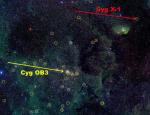 Cyg X-1: Can Black Holes Form in the Dark
12.06.2003
The formation of a black hole from the collapsing core of a massive star is thought to be heralded by a spectacular supernova explosion. Such an extremely energetic collapse is also a leading explanation for the mysterious cosmic gamma-ray bursts.
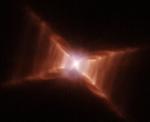 Rungs of the Red Rectangle
13.05.2004
A distinctive X-shape and ladder-like rungs appear in this Hubble Space Telescope image of the intriguing Red Rectangle Nebula. The dusty cosmic cloud was originally identified as a strong source of infrared radiation and is now believed to contain icy dust grains and hydrocarbon molecules formed in the cool outflow from an aging central star.
 Magnetar In The Sky
22.01.2000
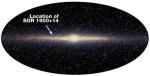
Indicated on this infrared image of the galactic center region is the position of SGR 1900+14 - the strongest known magnet in the galaxy. SGR 1900+14 is believed to be a city-sized, spinning, super-magnetic neutron star, or Magnetar. How strong is a Magnetar's magnetic field?
 The Tail of a Wonderful Star
17.08.2007
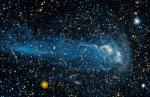
To seventeenth century astronomers, Omicron Ceti or Mira was known as a wonderful star, a star whose brightness could change dramatically in the course of about 11 months. Mira is now seen as the archetype of an entire class of long-period variable stars.
|
January February March April May June July August September |
|||||||||||||||||||||||||||||||||||||||||||||||||