
|
You entered: nebula
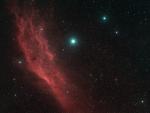 NGC 1499: California Nebula
10.03.2005
Drifting through the Orion Arm of the spiral Milky Way Galaxy, this cosmic cloud by chance echoes the outline of California on the west coast of the United States. Our own Sun also lies within the Milky Way's Orion Arm, only about 1,500 light-years from the California Nebula.
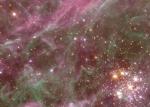 Denizen of the Tarantula Nebula
7.04.1999
The star cluster at lower right, cataloged as Hodge 301, is a denizen of the Tarantula Nebula. An evocative nebula in the southern sky, the sprawling cosmic Tarantula is an energetic star forming region some 168,000 light-years distant in our neighboring galaxy the Large Magellanic Cloud.
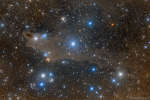 The Shark Nebula
7.09.2015
There is no sea on Earth large enough to contain the Shark nebula. This predator apparition poses us no danger, though, as it is composed only of interstellar gas and dust. Dark dust like that featured here is somewhat like cigarette smoke and created in the cool atmospheres of giant stars.
 APOD: 2024 September 17 Б Melotte 15 in the Heart Nebula
17.09.2024
Cosmic clouds form fantastic shapes in the central regions of emission nebula IC 1805. The clouds are sculpted by stellar winds and radiation from massive hot stars in the nebula's newborn star cluster, Melotte 15.
 APOD: 2026 January 26 Б NGC 55: A Galaxy of Nebulas
26.01.2026
Can you see nebulas in other galaxies? Yes, some nebulas shine brightly enough -- if you know how to look. Clouds of hydrogen and oxygen emit light at very specific colors, and by isolating them, astronomers and astrophotographers can reveal structures that would otherwise be too faint to notice.
 APOD: 2024 December 17 Б Near to the Heart Nebula
17.12.2024
What excites the Heart Nebula? First, the large emission nebula on the upper left, catalogued as IC 1805, looks somewhat like a human heart. The nebula glows brightly in red light emitted by its most prominent element, hydrogen, but this long-exposure image was also blended with light emitted by sulfur (yellow) and oxygen (blue).
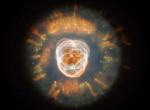 The Eskimo Nebula from the Newly Fixed Hubble
24.01.2000
In 1787, astronomer William Herschel discovered the Eskimo Nebula. From the ground, NGC 2392 resembles a person's head surrounded by a parka hood. In 2000, just after being fixed, the Hubble Space Telescope imaged the Eskimo Nebula. From space, the nebula displays gas clouds so complex they are not fully understood.
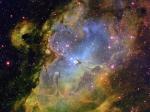 Inside the Eagle Nebula
26.02.2006
From afar, the whole thing looks like an Eagle. A closer look at the Eagle Nebula, however, shows the bright region is actually a window into the center of a larger dark shell of dust. Through this window, a brightly-lit workshop appears where a whole open cluster of stars is being formed.
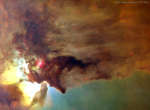 In the Center of the Lagoon Nebula
21.05.2017
The center of the Lagoon Nebula is a whirlwind of spectacular star formation. Visible on the lower left, at least two long funnel-shaped clouds, each roughly half a light-year long, have been formed by extreme stellar winds and intense energetic starlight. The tremendously bright nearby star, Hershel 36, lights the area.
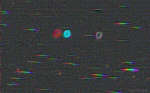 Colors: Ring Nebula versus Stars
21.07.2021
What if you could see, separately, all the colors of the Ring? And of the surrounding stars? There's technology for that. The featured image shows the Ring Nebula (M57) and nearby stars through such technology: in this case, a prism-like diffraction grating.
|
January February March April May |
|||||||||||||||||||||||||||||||||||||||||||||||||