
|
You entered: nebula
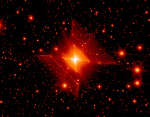 MWC 922: The Red Square Nebula
23.03.2011
What could cause a nebula to appear square? No one is quite sure. The hot star system known as MWC 922, however, appears to be embedded in a nebula with just such a shape. The above image combines infrared exposures from the Hale Telescope on Mt.
 APOD: 2023 August 28 Б Star Formation in the Pacman Nebula
28.08.2023
Look through the cosmic cloud cataloged as NGC 281 and you might miss the stars of open cluster IC 1590. Formed within the nebula, that cluster's young, massive stars ultimately power the pervasive nebular glow.
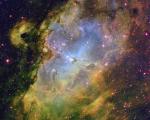 Inside the Eagle Nebula
21.09.2003
From afar, the whole thing looks like an Eagle. A closer look of the Eagle Nebula, however, shows the bright region is actually a window into the center of a larger dark shell of dust. Through this window, a brightly-lit workshop appears where a whole open cluster of stars is being formed.
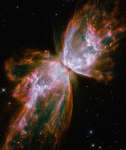 The Butterfly Nebula from Upgraded Hubble
10.09.2009
The bright clusters and nebulae of planet Earth's night sky are often named for flowers or insects, and NGC 6302 is no exception. With an estimated surface temperature of about 250,000 degrees...
 APOD: 2023 December 6 Б Stars Verus Dust in the Carina Nebula
6.12.2023
It's stars versus dust in the Carina Nebula and the stars are winning. More precisely, the energetic light and winds from massive newly formed stars are evaporating and dispersing the dusty stellar nurseries in which they formed.
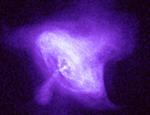 The Crab Nebula in X Rays
29.09.1999
Why does the Crab Nebula still glow? In the year 1054 A.D. a supernova was observed that left a nebula that even today glows brightly in every color possible, across the entire electromagnetic spectrum. At the nebula's center is an ultra-dense neutron star that rotates 30 times a second.
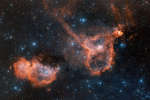 The Heart and Soul Nebulas
14.09.2008
Is the heart and soul of our Galaxy located in Cassiopeia? Possibly not, but that is where two bright emission nebulas nicknamed Heart and Soul can be found. The Heart Nebula, officially dubbed IC 1805 and visible in the above zoomable view on the right, has a shape reminiscent of a classical heart symbol.
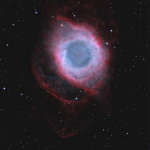 NGC 7293: The Helix Nebula
10.01.2014
A mere seven hundred light years from Earth, in the constellation Aquarius, a sun-like star is dying. Its last few thousand years have produced the Helix Nebula (NGC 7293), a well studied and nearby example of a Planetary Nebula, typical of this final phase of stellar evolution.
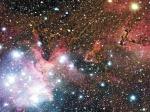 In the Center of the Heart Nebula
8.12.2004
What powers the Heart Nebula? The large emission nebula dubbed IC 1805 looks, in whole, like a human heart. The nebula glows brightly in red light emitted by its most prominent element: hydrogen. The red glow and the larger shape are all created by a small group of stars near the nebula's center.
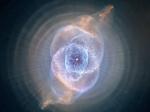 The Cats Eye Nebula from Hubble
13.05.2007
Staring across interstellar space, the alluring Cat's Eye nebula lies three thousand light-years from Earth. A classic planetary nebula, the Cat's Eye (NGC 6543) represents a final, brief yet glorious phase in the life of a sun-like star.
|
January February March April May |
|||||||||||||||||||||||||||||||||||||||||||||||||