
|
You entered: space
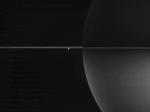 Thin Rings Around Polarized Saturn
19.12.2005
How thin are the rings of Saturn? Brightness measurements from different angles have shown Saturn's rings to be about one kilometer thick, making them many times thinner, in relative proportion, than a razor blade. This thinness sometimes appears in dramatic fashion during an image taken nearly along the ring plane.
 Flying Over the Earth at Night
31.03.2013
Many wonders are visible when flying over the Earth at night. A compilation of such visual spectacles was captured recently from the International Space Station (ISS) and set to rousing music. Passing below are white clouds, orange city lights, lightning flashes in thunderstorms, and dark blue seas.
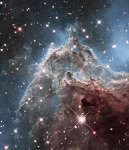 At the Edge of NGC 2174
3.04.2014
This fantastic skyscape lies near the edge of NGC 2174 a star forming region about 6,400 light-years away in the nebula-rich constellation of Orion. It follows mountainous clouds of gas and dust carved...
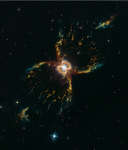 The Shape of the Southern Crab
24.04.2019
The symmetric, multi-legged appearance of the Southern Crab Nebula is certainly distinctive. About 7,000 light-years distant toward the southern sky constellation Centaurus, its glowing nested hourglass shapes are produced by the remarkable symbiotic binary star system at its center.
 APOD: 2026 May 16 Б Aurora Slathers Up the Sky
16.05.2026
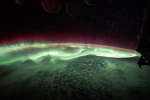
Like salsa verde on your favorite burrito, a green aurora slathers up the sky in this 2017 June 25 snapshot from the International Space Station. About 400 kilometers (250 miles) above Earth, the orbiting station is itself within the upper realm of the auroral displays.
 APOD: 2026 June 17 Б Longmore 8: The Hamster Wheel Nebula
17.06.2026
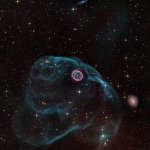
How did a hamster wheel get into space? The Hamster Wheel Nebula (Longmore 8) was discovered by Andrew Longmore in 1976 as a part of a larger survey of the southern sky. This survey...
 Supernova 1987a Fireball Resolved
24.01.1997
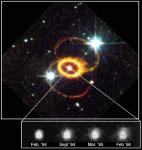
Ten years ago the most notable supernova of modern times was observed. In February 1987, light reached Earth from a star which exploded in the nearby Large Magellanic Cloud galaxy. Supernova 1987a remains the closest supernova since the invention of the telescope.
 Fast Stars and Rogue Planets in the Orion Nebula
21.03.2017
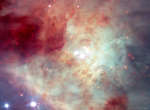
Start with the constellation of Orion. Below Orion's belt is a fuzzy area known as the Great Nebula of Orion. In this nebula is a bright star cluster known as the Trapezium, marked by four bright stars near the image center.
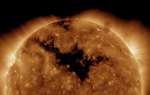 Hole in the Sun
28.08.2010
This ominous, dark shape sprawling across the face of the Sun is a coronal hole -- a low density region extending above the surface where the solar magnetic field opens freely into interplanetary space. Studied...
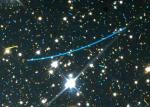 Asteroids in the Distance
23.06.2002
Rocks from space hit Earth every day. The larger the rock, though, the less often Earth is struck. Many kilograms of space dust pitter to Earth daily. Larger bits appear initially as a bright meteor. Baseball-sized rocks and ice-balls streak through our atmosphere daily, most evaporating quickly to nothing.
|
January February March April May June July August September |
|||||||||||||||||||||||||||||||||||||||||||||||||