
|
You entered: disk
 APOD: 2024 May 7 Б Black Hole Accreting with Jet
7.05.2024
What happens when a black hole devours a star? Many details remain unknown, but observations are providing new clues. In 2014, a powerful explosion was recorded by the ground-based robotic telescopes of the All Sky Automated Survey for SuperNovae (Project ASAS-SN), with followed-up observations by instruments including NASA's Earth-orbiting Swift satellite.
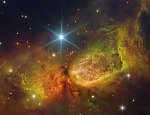 Star Forming Region S106
7.11.2011
Massive star IRS 4 is beginning to spread its wings. Born only about 100,000 years ago, material streaming out from this newborn star has formed the nebula dubbed Sharpless 2-106 Nebula (S106), pictured above.
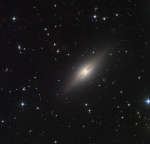 NGC 7814: The Little Sombrero in Pegasus
30.06.2017
Point your telescope toward the high flying constellation Pegasus and you can find this expanse of Milky Way stars and distant galaxies. Dominated by NGC 7814, the pretty field of view would almost be covered by a full moon.
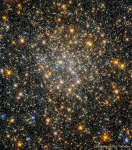 Palomar 6: Globular Star Cluster
19.10.2021
Where did this big ball of stars come from? Palomar 6 is one of about 200 globular clusters of stars that survive in our Milky Way Galaxy. These spherical star-balls are older than our Sun as well as older than most stars that orbit in our galaxy's disk.
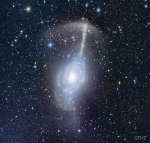 NGC 4651: The Umbrella Galaxy
7.02.2022
It's raining stars. What appears to be a giant cosmic umbrella is now known to be a tidal stream of stars stripped from a small satellite galaxy. The main galaxy, spiral galaxy...
 A Sky Full Of Hydrogen
18.12.1996
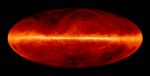
Interstellar space is filled with extremely tenuous clouds of gas which are mostly Hydrogen. The neutral hydrogen atom (HI in astronomer's shorthand) consists of 1 proton and 1 electron. The proton and electron spin like tops but can have only two orientations; spin axes parallel or anti-parallel.
 Galaxies Away
26.03.1998
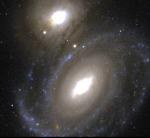
This striking pair of galaxies is far, far away ... about 350 million light-years from Earth. Cataloged as AM0500-620, the pair is located in the southern constellation Dorado. The background elliptical and foreground spiral galaxy are representative of two of the three major classes of galaxies which inhabit our Universe.
 NGC 1808: A Nearby Starburst Galaxy
1.07.1998
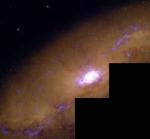
NGC 1808 is a galaxy in turmoil. A barred spiral with marked similarities to our home Milky Way Galaxy, NGC 1808 is distinguished by a peculiar nucleus, an unusually warped disk, and strange flows of hydrogen gas out from the central regions.
 NGC 7331 Close Up
7.02.2018
Big, beautiful spiral galaxy NGC 7331 is often touted as an analog to our own Milky Way. About 50 million light-years distant in the northern constellation Pegasus, NGC 7331 was recognized early on as a spiral nebula and is actually one of the brighter galaxies not included in Charles Messier's famous 18th century catalog.
 M22 and the Wanderers
12.04.2018
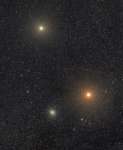
Wandering through the constellation Sagittarius, bright planets Mars and Saturn appeared together in early morning skies over the last weeks. They are captured in this 3 degree wide field-of-view from March 31 in a close celestial triangle with large globular star cluster Messier 22.
|
January February March April May June July August |
||||||||||||||||||||||||||||||||||||||||||||||||||||||||