
|
You entered: wind
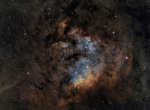 NGC 7822 in Cepheus
23.05.2015
Hot, young stars and cosmic pillars of gas and dust seem to crowd into NGC 7822. At the edge of a giant molecular cloud toward the northern constellation Cepheus, the glowing star forming region lies about 3,000 light-years away. Within the nebula, bright edges and dark shapes are highlighted in this colorful skyscape.
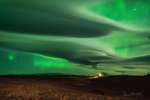 Aurora over Clouds
24.11.2015
Auroras usually occur high above the clouds. The auroral glow is created when fast-moving particles ejected from the Sun impact the Earth's magnetosphere, from which charged particles spiral along the Earth's magnetic field to strike atoms and molecules high in the Earth's atmosphere.
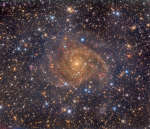 Hidden Galaxy IC 342
29.01.2016
Similar in size to large, bright spiral galaxies in our neighborhood, IC 342 is a mere 10 million light-years distant in the long-necked, northern constellation Camelopardalis. A sprawling island universe, IC 342 would otherwise...
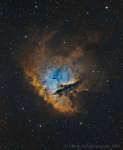 Portrait of NGC 281
22.11.2018
Look through the cosmic cloud cataloged as NGC 281 and you might miss the stars of open cluster IC 1590. Still, formed within the nebula that cluster's young, massive stars ultimately power the pervasive nebular glow.
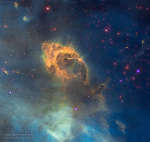 HH 666: Carina Dust Pillar with Jet
14.12.2021
To some, it may look like a beehive. In reality, the featured image from the Hubble Space Telescope captures a cosmic pillar of dust, over two-light years long, inside of which is Herbig-Haro 666 -- a young star emitting powerful jets.
 The Horsehead Nebula
10.12.2025
Sculpted by stellar winds and radiation, this dusty interstellar molecular cloud has by chance has assumed an immediately recognizable shape. Fittingly known as The Horsehead Nebula, it lies some 1,500 light-years distant, embedded in the vast Orion cloud complex.
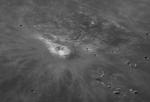 Aristarchus Plateau
30.11.2007
Anchored in the vast lava flows of the Moon's Oceanus Procellarum lies the Aristarchus Plateau. The bright impact crater at the corner of the plateau is Aristarchus, a young crater 42 kilometers wide and 3 kilometers deep. Only slightly smaller, lava flooded Herodotus crater is above and to the left.
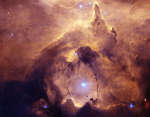 A Massive Star in NGC 6357
21.11.2010
For reasons unknown, NGC 6357 is forming some of the most massive stars ever discovered. One such massive star, near the center of NGC 6357, is framed above carving out its own interstellar castle with its energetic light from surrounding gas and dust.
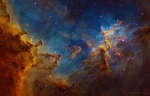 Melotte 15 in the Heart
18.10.2014
Cosmic clouds form fantastic shapes in the central regions of emission nebula IC 1805. The clouds are sculpted by stellar winds and radiation from massive hot stars in the nebula's newborn star cluster, Melotte 15.
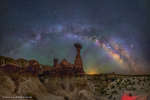 The Milky Way Over the Arizona Toadstools
22.02.2015
Which is older -- the rocks you see on the ground or the light you see from the sky? Usually its the rocks that are older, with their origin sentiments deposited well before light left any of the stars or nebulas you see in the sky.
|
January February March April May June |
|||||||||||||||||||||||||||||||||||||||||||||||||