
|
You entered: wind
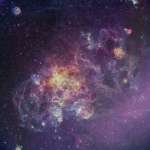
 The Tarantula Zone
26.04.2008
The Tarantula Nebula is more than 1,000 light-years in diameter -- a giant star forming region within our neighboring galaxy the Large Magellanic Cloud (LMC). That cosmic arachnid lies at the upper left of this expansive mosiac covering a part of the LMC over 6,000 light-years across.
 The Tarantula Zone
16.09.2009
The Tarantula Nebula is more than 1,000 light-years in diameter -- a giant star forming region within our neighboring galaxy the Large Magellanic Cloud (LMC). That cosmic arachnid lies left of center in this in this colorful telescopic image taken through narrow-band filters. It covers a part of the LMC over 2,000 light-years across.
 Thor s Helmet
7.03.2013
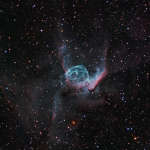
This helmet-shaped cosmic cloud with wing-like appendages is popularly called Thor's Helmet. Heroically sized even for a Norse god, Thor's Helmet is about 30 light-years across. In fact, the helmet is actually...
 Bright from the Heart Nebula
27.10.2015
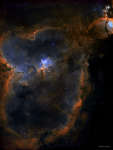
What's that inside the Heart Nebula? First, the large emission nebula dubbed IC 1805 looks, in whole, like a human heart. The nebula glows brightly in red light emitted by its most prominent element: hydrogen.
 The Keyhole in the Carina Nebula
14.08.2016
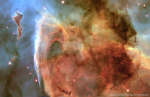
The dark dusty Keyhole Nebula gets its name from its unusual shape. The looping Keyhole, in this featured classic image by the Hubble Space Telescope, is a smaller region inside the larger Carina Nebula.
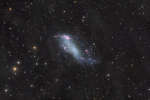 IC 2574: Coddington s Nebula
19.02.2026
Grand spiral galaxies often seem to get all the glory, flaunting their young, bright, blue star clusters in beautiful, symmetric spiral arms. But small, irregular galaxies form stars too. In fact, dwarf galaxy IC 2574 shows clear evidence of intense star forming activity in its telltale reddish regions of glowing hydrogen gas.
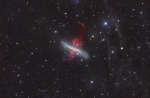 APOD: 2026 April 17 Б M82: Starburst Galaxy with a Superwind
17.04.2026
Messier 82 is a starburst galaxy with a superwind. In fact, through supernova explosions and powerful winds from massive stars, the burst of star formation in M82 is driving a prodigious outflow. Evidence for the superwind from the galaxy's central regions is clear in the sharp telescopic portrait.
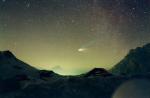 Comet Hale Bopp Over Val Parola Pass
28.06.1998
In 1997, Comet Hale-Bopp became much brighter than any surrounding stars. It could be seen even over bright city lights. Out away from city lights, however, it put on quite a spectacular show. Here Comet Hale-Bopp was photographed last March above Val Parola Pass in the Dolomite mountains surrounding Cortina d'Ampezzo, Italy.
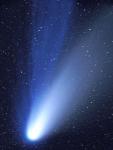 The Dust and Ion Tales of Comet Hale-Bopp
22.05.2005
In 1997, Comet Hale-Bopp's intrinsic brightness exceeded any comet since 1811. Since it peaked on the other side of the Earth's orbit, however, the comet appeared only brighter than any comet in two decades. Visible above are the two tails shed by Comet Hale-Bopp.
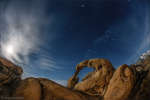 Mobius Arch Moonrise
28.02.2014
Only two days past full, February's moon shines through thin clouds, rising on the left in this fisheye night skyscape. The moonlight illuminates a weathered, rounded foreground in the Alabama Hills, conveniently located east of Mt. Whitney along the Sierra Nevada range in California, USA, planet Earth.
|
January February March April May June |
|||||||||||||||||||||||||||||||||||||||||||||||||