
|
You entered: peculiar
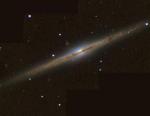 Edge-On Spiral Galaxy NGC 891
28.02.1997
Is our Galaxy this thin? We believe so. The Milky Way, like NGC 891 pictured above, has the width of a typical spiral galaxy. Spirals have most of their bright stars, gas, and obscuring dust in a thin disk.
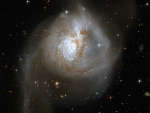 Galaxies Collide in NGC 3256
6.05.2008
Galaxies don't normally look like this. NGC 3256 actually shows a current picture of two galaxies that are slowly colliding. Quite possibly, in hundreds of millions of years, only one galaxy will remain.
 APOD: 2025 July 14 Б NGC 2685: The Helix Galaxy
14.07.2025
What is going on with this galaxy? NGC 2685 is a confirmed polar ring galaxy - a rare type of galaxy with stars, gas and dust orbiting in rings perpendicular to the plane of a flat galactic disk.
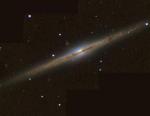 Edge On Spiral Galaxy NGC 891
20.12.1998
Is our Galaxy this thin? We believe so. The Milky Way, like NGC 891 pictured above, has the width of a typical spiral galaxy. Spirals have most of their bright stars, gas, and obscuring dust in a thin disk.
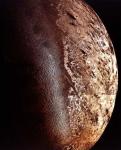 Triton: Neptune's Largest Moon
10.10.1999
One hundred and fifty three years ago, on October 10th, 1846, William Lassell was observing the newly discovered planet Neptune. He was attempting to confirm his observation, made just the previous week, that Neptune had a ring. But this time he discovered that Neptune had a satellite as well.
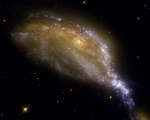 A Galaxy Collision in NGC 6745
30.09.2012
Galaxies don't normally look like this. NGC 6745 actually shows the results of two galaxies that have been colliding for only hundreds of millions of years. Just off the above digitally sharpened photograph to the lower right is the smaller galaxy, moving away.
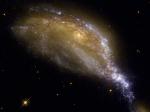 A Galaxy Collision in NGC 6745
5.11.2006
Galaxies don't normally look like this. NGC 6745 actually shows the results of two galaxies that have been colliding for only hundreds of millions of years. Just off the above photograph to the lower right is the smaller galaxy, moving away.
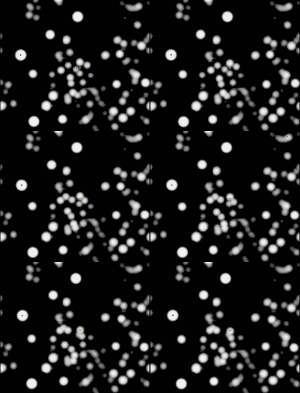 Sgr A*: Fast Stars Near the Galactic Center
14.01.2007
Why are these stars moving so fast? Shown above is a time-lapse movie in infrared light detailing how stars in the central light-year of our Galaxy have moved over the past eight years.
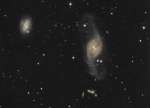 Extra Galaxies
17.07.2008
(xxxedit and linkxxx) A careful look at the full field of view for this sharp image reveals a surprising number of galaxies both near and far toward the constellation Ursa Major. The most striking is clearly NGC 3718, the warped spiral galaxy right of center.
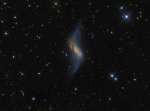 Polar Ring Galaxy NGC 660
22.01.2011
NGC 660 lies near the center of this intriguing skyscape, swimming in the boundaries of the constellation Pisces. Over 20 million light-years away, its peculiar appearance marks it as a polar ring galaxy.
|
January February March April May June July August |
||||||||||||||||||||||||||||||||||||||||||||||||||||||||