
|
You entered: peculiar
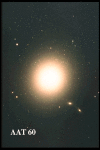 Elliptical Galaxy M87
13.09.1995
Elliptical galaxy M87 is a type of galaxy that looks much different than our own Milky Way Galaxy. But even for an elliptical galaxy M87 is peculiar. M87 is much bigger than an average...
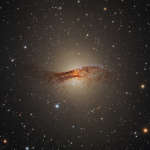 Centaurus A
12.07.2018
Only 11 million light-years away, Centaurus A is the closest active galaxy to planet Earth. Spanning over 60,000 light-years, the peculiar elliptical galaxy also known as NGC 5128, is featured in this sharp telescopic view.
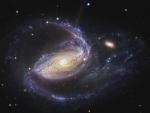 In the Arms of NGC 1097
1.12.2006
A smaller companion seems wrapped in the spiral arms of enigmatic galaxy NGC 1097. This amazingly deep image of the peculiar spiral system, also known as Arp 77, actually combines data from two telescopes, one in the northern and one in the southern hemisphere of planet Earth.
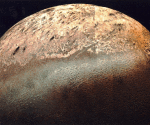 Triton: Neptune's Largest Moon
23.11.1997
On October 10th, 1846, William Lassell was observing the newly discovered planet Neptune. He was attempting to confirm his observation, made just the previous week, that Neptune had a ring. But this time he discovered that Neptune had a satellite as well.
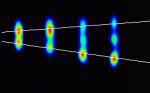 Micro-Quasar GRS1915 Puffs
2.12.1997
On the far side of our Galaxy, gas clouds explode away from a small black hole. This might seem peculiar, as black holes are supposed to attract matter. But material falling toward a black hole collides and heats up, creating an environment similar to a quasar that is far from stable.
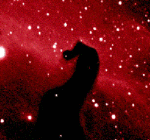 A Close-Up of the Horsehead Nebula
5.10.1996
1500 light years away lies a nebula of quite peculiar shape. How did the dark dust cloud shown above come to be shaped like a horse's head? Nobody knows! Barnard 33, as this...
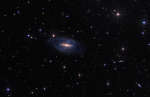 Polar Ring Galaxy NGC 2685
14.03.2014
NGC 2685 is a confirmed polar ring galaxy - a rare type of galaxy with stars, gas and dust orbiting in rings perpendicular to the plane of a flat galactic disk. The bizarre configuration could...
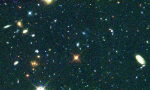 Watch Galaxies Form
5.09.1996
Snips and snails and puppy dog tails, is that what galaxies were made of? In a report released yesterday and soon to be published in Nature, astronomers have imaged an interesting distant patch of sky with the orbiting Hubble Space Telescope.
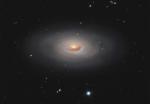 M64: The Black Eye Galaxy
2.08.2007
This bright, beautiful spiral galaxy is Messier 64, sometimes known as the Black Eye Galaxy. M64 lies about 17 million light-years distant in the otherwise well-groomed northern constellation Coma Bernices. The dark clouds along...
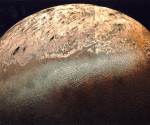 Triton: Neptune's Largest Moon
10.10.1996
Today marks the 150th anniversary of the discovery of Triton. On October 10 1846, William Lassell was observing the newly discovered planet Neptune. He was attempting to confirm his observation, made just the previous week, that Neptune had a ring. But this time he discovered that Neptune had a satellite as well.
|
January February March April May June July August |
||||||||||||||||||||||||||||||||||||||||||||||||||||||||