
|
You entered: flare
 Orange Sun Sparking
6.05.2014
Our Sun has become quite a busy place. Taken only two weeks ago, the Sun was captured sporting numerous tumultuous regions including active sunspot regions AR 2036 near the image top and AR 2036 near the center.
 The Sun Erupts
16.09.1996
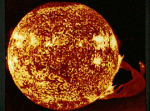
The Sun is a seething ball of extremely hot gas. Above, the Sun was captured by Skylab in 1973 throwing off one the largest eruptive prominences in recorded history. The Sun has survived for about 5 billion years, and will likely survive for another 5 billion.
 The Sun Erupts
30.08.1998
The Sun is a seething ball of extremely hot gas. Above, the Sun was captured by Skylab in 1973 throwing off one the largest eruptive prominences in recorded history. The Sun has survived for about 5 billion years, and will likely survive for another 5 billion.
 Calm Waters and Geomagnetic Storm
9.09.2017
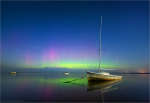
Very recognizable stars of the northern sky are a backdrop for calm waters in this moonlit sea and skyscape off Cape Cod, Massachusetts. Taken on September 7, the photo also records a colorful display of northern lights or aurora borealis triggered by a severe geomagnetic storm.
 Dawn s Endeavour
27.02.2010
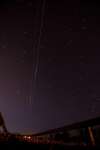
On February 21st, the Space Shuttle Endeavour and the International Space Station (ISS) flew through the sky near dawn over Whitby, Ontario, Canada. Along with star trails, both were captured in this single time exposure. Glinting in sunlight 350 kilometers above the Earth, Endeavour slightly preceeded the ISS arcing over the horizon.
 A Solar Corona Ejection
8.11.1996
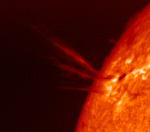
The Sun would not be a nice place to spend the summer. One reason, besides the extreme heat, is that explosions are common there. In the above picture, magnetic fields buckle releasing previously constrained hot material from the upper atmosphere of the Sun.
 The Sun Erupts
13.08.1995
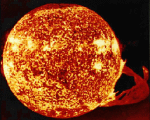
The sun was captured in 1973 throwing one of the largest eruptive prominences ever recorded. Sol, our sun, is a normal star. It formed about 5 billion years ago, and will last about another 5 billion years. The sun will never explode, and a solar flare will never destroy the earth.
 A Setting Sun Trail
29.07.2002
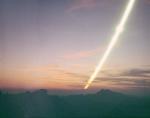
The Sun appears to move on the sky because the Earth rotates. The extreme brightness of the Sun, however, makes it difficult to capture a sun-trail -- the path the Sun traces on the sky.
 Shuttle Engine Blast
8.03.1998
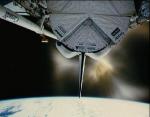
The Space Shuttle Discovery's orbital maneuvering system (OMS) engine firing produced this dramatic flare as it cruised "upside down" in low Earth orbit. Discovery was named for a ship commanded by Captain James Cook RN, the 18th Century English astronomer and navigator.
 Edge on NGC 3628
20.06.2013
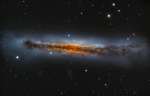
Sharp telescopic views of magnificent edge-on spiral galaxy NGC 3628 show a puffy galactic disk divided by dark dust lanes. Of course, this deep galactic portrait puts some astronomers in mind of its popular moniker, The Hamburger Galaxy.
|
January February March April May June July August September |
|||||||||||||||||||||||||||||||||||||||||||||||||