
|
You entered: emission
 APOD: 2023 August 22 Б The Pistachio Nebula
21.08.2023
This nebula had never been noted before. Newly discovered nebulas are usually angularly small and found by professionals using large telescopes. In contrast, the Pistachio Nebula was discovered by dedicated amateurs and, although faint, is nearly the size of the full Moon.
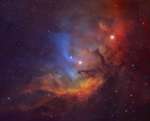 The Tulip in the Swan
26.07.2012
Framing a bright emission region this telescopic view looks out along the plane of our Milky Way Galaxy toward the nebula rich constellation Cygnus the Swan. Popularly called the Tulip Nebula the glowing cloud of interstellar gas and dust is also found in the 1959 catalog by astronomer Stewart Sharpless as Sh2-101.
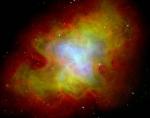 The Crab Nebula Pulsar Shrugs
20.09.2002
How does a city-sized neutron star power the vast Crab Nebula? The expulsion of wisps of hot gas at high speeds appears to be at least part of the answer. Yesterday time-lapse movies taken...
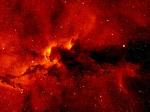 IC 1396 Close Up
30.09.2005
Clouds of glowing hydrogen gas mingle ominously with dark dust lanes in this close-up of IC 1396, an active star forming region some 2,000 light years away in the constellation Cepheus. In this and other similar emission nebulae, energetic ultraviolet light from a hot young star strips electrons from the surrounding hydrogen atoms.
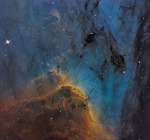 Pelican Nebula Close Up
26.11.2011
The prominent ridge of emission featured in this vivid skyscape is designated IC 5067. Part of a larger emission nebula with a distinctive shape, popularly called The Pelican Nebula, the ridge spans about 10 light-years and follows the curve of the cosmic pelican's head and neck.
 North America and the Pelican
3.09.2013
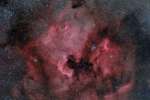
Here lie familiar shapes in unfamiliar locations. On the left is an emission nebula cataloged as NGC 7000, famous partly because it resembles our fair planet's continent of North America. The emission region to the right of the North America Nebula is IC 5070, also known for its suggestive outlines as the Pelican Nebula.
 Planetary Nebula Abell 78
15.10.2020
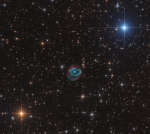
Planetary nebula Abell 78 stands out in this colorful telescopic skyscape. In fact the colors of the spiky Milky Way stars depend on their surface temperatures, both cooler (yellowish) and hotter (bluish) than the Sun.
 Supernova Remnant CTA 1
22.08.2024
There is a quiet pulsar at the heart of CTA 1. The supernova remnant was discovered as a source of emission at radio wavelengths by astronomers in 1960 and since identified as the result of the death explosion of a massive star.
 Elephant, Bat, and Squid
22.07.2021
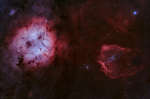
Sprawling emission nebulae IC 1396 and Sh2-129 mix glowing interstellar gas and dark dust clouds in this 10 degree wide field of view toward the northern constellation Cepheus the King. Energized by its bluish central star IC 1396 (left) is hundreds of light-years across and some 3,000 light-years distant.
 The Horsehead and Flame Nebulas
2.11.2021
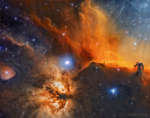
The Horsehead Nebula is one of the most famous nebulae on the sky. It is visible as the dark indentation to the orange emission nebula at the far right of the featured picture. The horse-head feature is dark because it is really an opaque dust cloud that lies in front of the bright emission nebula.
|
January February March April May June July August |
||||||||||||||||||||||||||||||||||||||||||||||||||||||||