
|
You entered: emission
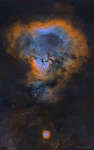 NGC 7822: Cosmic Question Mark
13.10.2021
It may look like a huge cosmic question mark, but the big question really is how does the bright gas and dark dust tell this nebula's history of star formation. At the edge...
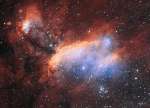 IC 4628: The Prawn Nebula
23.09.2013
South of Antares, in the tail of the nebula-rich constellation Scorpius, lies emission nebula IC 4628. Nearby hot, massive stars, millions of years young, radiate the nebula with invisible ultraviolet light, stripping electrons from atoms. The electrons eventually recombine with the atoms to produce the visible nebular glow, dominated by the red emission of hydrogen.
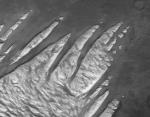 White Rock Fingers on Mars
13.05.2002
What caused this unusual white rock formation on Mars? Intrigued by the possibility that they could be salt deposits left over as an ancient lakebed dried-up, detailed studies of these fingers now indicate a more mundane origin: volcanic ash. Studying the exact color of the formation indicated the volcanic origin.
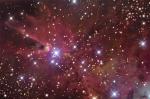 The Mysterious Cone Nebula
25.12.2005
Sometimes the simplest shapes are the hardest to explain. For example, the origin of the mysterious cone-shaped region seen on the far left remains a mystery. The interstellar formation, dubbed the Cone Nebula, is located about 2700 light years away.
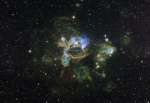 The N44 Complex
27.03.2008
A truly giant complex of emission nebulae, N44 is about 1,000 light-years across. It shines in southern skies as a denizen of our neighboring galaxy, the Large Magellanic Cloud, 170,000 light-years away.
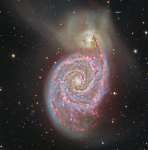 Hydrogen in M51
11.06.2010
Perhaps the original spiral nebula, M51 is a large galaxy, over 60,000 light-years across, with a readily apparent spiral structure. Also cataloged as NGC 5194, M51 is a part of a well-known interacting galaxy pair, its spiral arms and dust lanes clearly sweeping in front of companion galaxy NGC 5195 (top).
 X Ray Cygnus A
10.11.2000
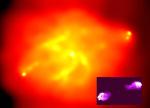
Amazingly detailed, this false-color x-ray image is centered on the galaxy Cygnus A. Recorded by the orbiting Chandra Observatory, Cygnus A is seen here as a spectacular high energy x-ray source. But it is actually more famous at the low energy end of the electromagnetic spectrum as one of the brightest celestial radio sources.
 X Ray Cygnus A
5.10.2002
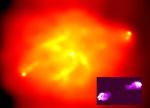
Amazingly detailed, this false-color x-ray image is centered on the galaxy Cygnus A. Recorded by the orbiting Chandra Observatory, Cygnus A is seen here as a spectacular high energy x-ray source. But it is actually more famous at the low energy end of the electromagnetic spectrum as one of the brightest celestial radio sources.
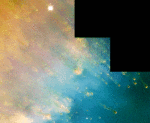 At the Edge of the Helix
22.04.1996
While exploring the inner edge of the Helix Nebula with the Hubble Space Telescope's Wide Field Planetary Camera 2, astronomers were able to produce this striking image - rich in details of an exotic environment.
 At the Edge of the Helix
20.07.1997
While exploring the inner edge of the Helix Nebula with the Hubble Space Telescope's Wide Field Planetary Camera 2, astronomers were able to produce this striking image - rich in details of an exotic environment.
|
January February March April May June July August |
||||||||||||||||||||||||||||||||||||||||||||||||||||||||