
|
You entered: image
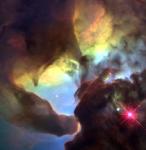 Twistin' by the Lagoon
23.01.1997
The awesome spectacle of starbirth produces extreme stellar winds and intense energetic starlight -- bombarding dusty molecular clouds inside the Lagoon Nebula (M8). At least two long funnel shaped clouds, each roughly half a light-year long, have apparently been formed by this activity.
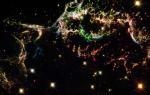 Recycling Cassiopeia A
30.08.2003
For billions of years, massive stars in our Milky Way Galaxy have lived spectacular lives. Collapsing from vast cosmic clouds, their nuclear furnaces ignite and create heavy elements in their cores. After a few million years, the enriched material is blasted back into interstellar space where star formation begins anew.
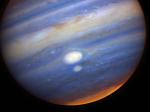 Jupiters Two Largest Storms Nearly Collide
25.07.2006
Two storms systems larger than Earth are nearly colliding right now on planet Jupiter. No one was sure what would happen, but so far both storms have survived. In the above false-color infrared image...
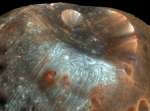 Stickney Crater
10.04.2008
Stickney Crater, the largest crater on the martian moon Phobos, is named for Chloe Angeline Stickney Hall, mathematician and wife of astronomer Asaph Hall. Asaph Hall discovered both the Red Planet's moons in 1877.
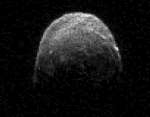 Asteroid 2005 YU55 Passes the Earth
9.11.2011
Asteroid 2005 YU55 passed by the Earth yesterday, posing no danger. The space rock, estimated to be about 400 meters across, coasted by just inside the orbit of Earth's Moon. Although the passing...
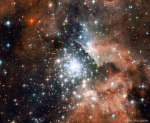 Starburst Cluster in NGC 3603
6.11.2016
A mere 20,000 light-years from the Sun lies NGC 3603, a resident of the nearby Carina spiral arm of our Milky Way Galaxy. NGC 3603 is well known to astronomers as one of the Milky Way's largest star-forming regions.
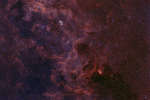 Cosmic Clouds in Cygnus
9.06.2022
These cosmic clouds of gas and dust drift through rich star fields along the plane of our Milky Way Galaxy toward the high flying constellation Cygnus. They're too faint to be seen with the unaided eye though, even on a clear, dark night.
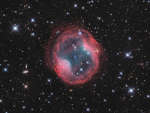 Jones Emberson 1
24.02.2023
Planetary nebula Jones-Emberson 1 is the death shroud of a dying Sun-like star. It lies some 1,600 light-years from Earth toward the sharp-eyed constellation Lynx. About 4 light-years across, the expanding remnant...
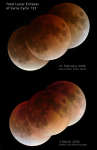 APOD: 2026 March 7 Б Two Eclipses of Saros 133
7.03.2026
Centered on maximum eclipse, these two total lunar eclipse sequences look almost identical. Yet the one shown on top is composed of images recorded in February 2008, while at the bottom is the recent March 2026 total eclipse of the Moon. Why are they so similar?
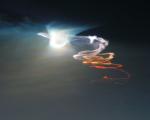 Rocket Trail at Sunset
26.09.2002
Bright light from a setting Sun and pale glow from a rising Moon both contribute to this stunning picture of a rocket exhaust trail twisting and drifting in the evening sky. Looking west...
|
January February March April May June July August September |
|||||||||||||||||||||||||||||||||||||||||||||||||