
|
You entered: image
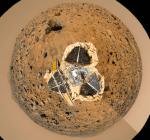 Slightly Above Mars Pathfinder
12.09.2000
If you could have hovered above the Pathfinder mission to Mars in 1997, this is what you might have seen. Directly below you is the control tower of Sagan Memorial Station. Three dark solar...
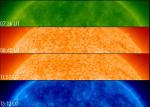 Mercury Spotting
8.05.2003
Can you spot the planet? The diminutive disk of Mercury, the solar system's innermost planet, spent about five hours crossing in front of the enormous solar disk yesterday (Wednesday, May 7th), as viewed from the general vicinity of planet Earth.
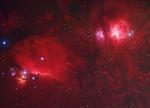 An Orion Deep Field
15.01.2004
Adrift 1,500 light-years away in one of the night sky's most recognizable constellations, the glowing Orion Nebula and the dark Horsehead Nebula are contrasting cosmic vistas. They both appear in this stunning composite digital image assembled from over 20 hours of data that includes exposures filtered to record emission from hydrogen atoms.
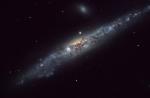 NGC 4631: The Whale Galaxy
23.01.2004
NGC 4631 is a big beautiful spiral galaxy seen edge-on only 25 million light-years away towards the small northern constellation Canes Venatici. This galaxy's slightly distorted wedge shape suggests to some a cosmic herring and to others the popular moniker of The Whale Galaxy.
 N49's Cosmic Blast
6.03.2004
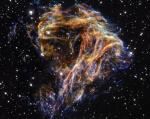
Scattered debris from a cosmic supernova explosion lights up the sky in this gorgeous composited image based on data from the Hubble Space Telescope. Cataloged as N49, these glowing filaments of shocked gas span about 30 light-years in our neighboring galaxy, the Large Magellanic Cloud.
 M81 and M82: GALEX Full Field
30.12.2004
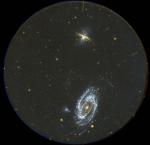
Intriguing galaxy pair M81 and M82 shine in this full-field view from the orbiting GALEX observatory. GALEX - the Galaxy Evolution Explorer - scans the cosmos in ultraviolet light, a view that follows star formation and galaxy evolution through the Universe.
 G21.5-0.9: A Supernova s Cosmic Shell
21.04.2005
The picture is lovely, but this pretty cosmic shell was produced by almost unbelievable violence - created when a star with nearly 20 times the mass of the sun blasted away its outer layers in a spectacular supernova explosion.
 A Nearby Supernova in M51
19.07.2005
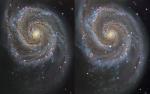
One of the nearest supernovas of recent years was discovered late last month in the bright nearby galaxy M51. It is visible on the right of the above before and after images of the picturesque spiral. Can you spot it?
 Messier Marathon
11.03.2000
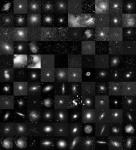
Gripped by an astronomical spring fever, it's once again time for many amateur stargazers to embark on a Messier Marathon! The Vernal Equinox occurs March 20, marking the first day of Spring for the Northern Hemisphere.
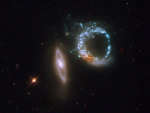 The Double Ring Galaxies of Arp 147 from Hubble
4.11.2008
How could a galaxy become shaped like a ring? Even more strange: how could two? The rim of the blue galaxy pictured on the right shows an immense ring-like structure 30,000 light years in diameter composed of newly formed, extremely bright, massive stars.
|
January February March April May June July August September |
|||||||||||||||||||||||||||||||||||||||||||||||||