
|
You entered: image
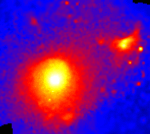 The Virgo Cluster: Hot Plasma and Dark Matter
19.04.1996
This ROSAT image of the Virgo cluster of galaxies reveals a hot X-ray emitting plasma or gas with a temperature of 10-100 million degrees pervading the cluster. False colors have been used to represent the intensity of X-ray emission.
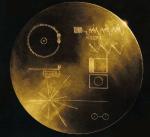 The Voyagers' Message in a Bottle
31.08.2002
Launched twenty-five years ago, NASA's Voyager 1 and 2 spacecraft are now over 10 billion kilometers from the Sun. Still operational, the Voyagers are being tracked and commanded through the Deep Space Network.
 A Perseid Meteor
11.08.2004
The ongoing Perseid Meteor Shower should be at its strongest tonight and tomorrow night. Although meteors should be visible all night long, the best time to watch will be between 2:00 AM and dawn each night. In dark, moonless, predawn skies you may see dozens of meteors per hour.
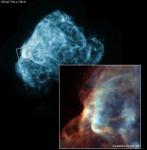 Supernova Remnant and Shock Wave
17.02.2006
A massive star ends life as a supernova, blasting its outer layers back to interstellar space. The spectacular death explosion is initiated by the collapse of what has become an impossibly dense stellar core. Pictured is the expanding supernova remnant Puppis A - one of the brightest sources in the x-ray sky.
 Markarians Chain of Galaxies
11.10.2006
Across the heart of the Virgo Cluster of Galaxies lies a striking string of galaxies known as Markarian's Chain. The chain, pictured above, is highlighted on the lower right with two large but featureless lenticular galaxies, M84 and M86, and connects through several large spiral to the upper left, including M88.
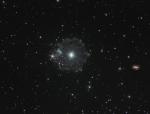 Cat s Eye Wide and Deep
29.06.2007
The Cat's Eye Nebula (NGC 6543) is one of the best known planetary nebulae in the sky. Its more familiar outlines are seen in the the brighter central region of this impressive wide-angle view. But the composite image also combines many short and long exposures to reveal the nebula's extremely faint halo.
 Gigantic Jets Over Oklahoma
29.08.2007
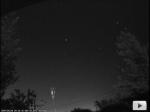
Have you ever seen a gigantic jet? They are extremely rare but tremendously powerful. Gigantic jets are a newly discovered type of lightning discharge between some thunderstorms and the Earth's ionosphere high above them. Pictured above is one such jet caught by accident by a meteor camera in Oklahoma, USA.
 X Ray Stars of Orion
6.10.2007
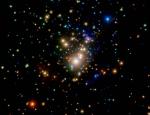
The stars of Orion shine brightly in visible light in planet Earth's night sky. The constellation harbors the closest large stellar nursery, the Great Nebula of Orion, a mere 1,500 light-years away.
 An Extraordinary Voyage
17.10.2008
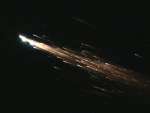
Nineteenth century science fiction author Jules Verne wrote visionary works about Extraordinary Voyages including tales of space flight and the story of a journey From the Earth to the Moon. Fittingly, the European Space...
 Moons Beyond the Rings of Saturn
12.07.2010
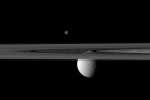
What's happened to that moon of Saturn? Nothing -- Saturn's moon Rhea is just partly hidden behind Saturn's rings. In April, the robotic Cassini spacecraft now orbiting Saturn took this narrow-angle view looking across the Solar System's most famous rings.
|
January February March April May June July August September |
|||||||||||||||||||||||||||||||||||||||||||||||||