
|
You entered: space
 Posters of the Solar System
18.05.2020
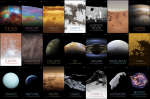
Would you like a NASA astronomy-exploration poster? You are just one page-print away. Any of the panels you see on the featured image can appear on your wall. Moreover, this NASA page has, typically, several more posters of each of the Solar System objects depicted.
 Spiral Galaxy M74: A Sharper View
21.07.2022
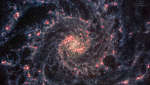
Beautiful spiral galaxy Messier 74 (also known as NGC 628) lies some 32 million light-years away toward the constellation Pisces. An island universe of about 100 billion stars with two prominent spiral arms, M74 has long been admired by astronomers as a perfect example of a grand-design spiral galaxy.
 Asteroids in the Distance
10.02.2013
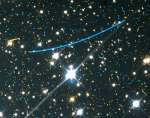
Rocks from space hit Earth every day. The larger the rock, though, the less often Earth is struck. Many kilograms of space dust pitter to Earth daily. Larger bits appear initially as a bright meteor. Baseball-sized rocks and ice-balls streak through our atmosphere daily, most evaporating quickly to nothing.
 The Tarantula Nebula from Spitzer
1.02.2004
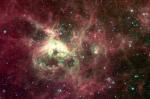
In the heart of monstrous Tarantula Nebula lies one of the most unusual star clusters. Known as NGC 2070 or R136, it is home to a great number of hot young stars. The energetic light from these stars continually ionizes nebula gas, while their energetic particle wind blows bubbles and defines intricate filaments.
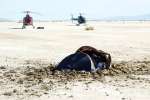 Genesis Missions Hard Impact
5.07.2009
A flying saucer from outer space crash-landed in the Utah desert in 2004 after being tracked by radar and chased by helicopters. No space aliens were involved, however. The saucer, pictured above, was the Genesis sample return capsule, part of a human-made robot Genesis spaceship launched in 2001 by NASA itself to study the Sun.
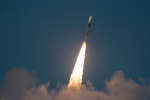 Hitomi Launches
17.02.2016
On February 17 at 5:45pm JST this H-IIA rocket blasted skyward from JAXA's Tanegashima Space Center located off the southern coast of Japan, planet Earth. Onboard was the ASTRO-H X-ray astronomy satellite, now in orbit.
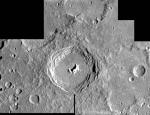 SMART 1: Pythagoras Crater
2.02.2005
Stark shadows show off the central peaks and terraced walls of 120 kilometer wide Pythagoras Crater in this mosaic of images from ESA's SMART-1 spacecraft. Characteristic of large, complex impact craters on the Moon, the central uplift was produced by a rebound of the suddenly molten lunar crust during the violent impact event.
 Shocked by Supernova 1987A
27.02.2012
Twenty five years ago, the brightest supernova of modern times was sighted. Over time, astronomers have watched and waited for the expanding debris from this tremendous stellar explosion to crash into previously expelled material.
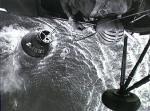 Liberty Bell 7
6.05.1999
Today, the space capsule Liberty Bell 7 rests about 3 miles below the surface of the Atlantic Ocean. But on July 21, 1961, astronaut Virgil I. "Gus" Grissom rode this tiny craft 118 miles above the Earth to become the second American in space.
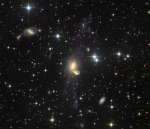 Recycling NGC 5291
20.11.2015
Following an ancient galaxy-galaxy collision 200 million light-years from Earth, debris from a gas-rich galaxy, NGC 5291, was flung far into intergalactic space. NGC 5291 and the likely interloper, also known as the "Seashell" galaxy, are captured near the center of this spectacular scene.
|
January February March April May June July August September |
|||||||||||||||||||||||||||||||||||||||||||||||||