
|
You entered: image
 Earth at Night
22.08.2004
This is what the Earth looks like at night. Can you find your favorite country or city? Surprisingly, city lights make this task quite possible. Human-made lights highlight particularly developed or populated areas of the Earth's surface, including the seaboards of Europe, the eastern United States, and Japan.
 Ultraviolet Andromeda
27.10.2010
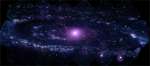
This stunning vista represents the highest resolution image ever made of the Andromeda Galaxy (aka M31) at ultraviolet wavelengths. Recorded by NASA's Swift satellite, the mosaic is composed of 330 individual images covering a region 200,000 light-years wide.
 APOD: 2026 April 7 Б IC 4592: The Blue Horsehead Reflection Nebula
6.04.2026
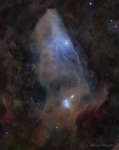
Do you see the horse's head? What you are seeing is not the famous Horsehead nebula toward Orion, but rather a fainter nebula that only takes on a familiar form with deeper imaging. The main part of the here-imaged molecular cloud complex is reflection nebula IC 4592.
 Venusian Half Shell
10.12.2001
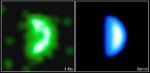
Venus, second planet from the Sun, appears above imaged for the first time ever in x-rays (left) by the orbiting Chandra Observatory. Chandra's smoothed, false-color, x-ray view is compared to an optical image (right) from a small earthbound telescope.
 Andromeda over Patagonia
24.11.2020
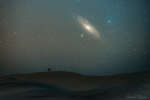
How far can you see? The Andromeda Galaxy at 2.5 million light years away is the most distant object easily seen with your unaided eye. Most other apparent denizens of the night sky -- stars...
 The Einstein Cross Gravitational Lens
16.12.2017
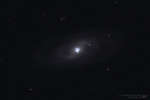
Most galaxies have a single nucleus -- does this galaxy have four? The strange answer leads astronomers to conclude that the nucleus of the surrounding galaxy is not even visible in this image. The central cloverleaf is rather light emitted from a background quasar.
 The Horsehead Nebula
16.12.2019
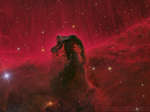
Sculpted by stellar winds and radiation, a magnificent interstellar dust cloud by chance has assumed this recognizable shape. Fittingly named the Horsehead Nebula, it is some 1,500 light-years distant, embedded in the vast Orion cloud complex.
 Moon Pairs and the Synodic Month
25.09.2020
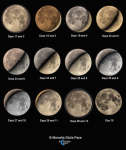
Observe the Moon each night and its visible sunlit portion will gradually change. In phases progressing from New Moon to Full Moon to New Moon again, a lunar cycle or synodic month is completed in about 29.5 days.
 Cassini Spacecraft Crosses Saturns Ring Plane
28.12.2019
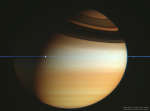
If this is Saturn, where are the rings? When Saturn's "appendages" disappeared in 1612, Galileo did not understand why. Later that century, it became understood that Saturn's unusual protrusions were rings and that when the Earth crosses the ring plane, the edge-on rings will appear to disappear.
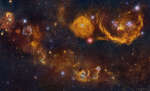 From Auriga to Orion
21.03.2021
What's up in the sky from Auriga to Orion? Many of the famous stars and nebulas in this region were captured on 34 separate images, taking over 430 hours of exposure, and digitally combined to reveal the featured image.
|
January February March April May June July August September |
|||||||||||||||||||||||||||||||||||||||||||||||||