
|
You entered: image
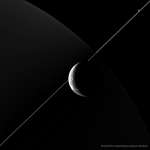 APOD: 2015 July 8 In the Company of Dione
8.07.2015
That is not our Moon. It's Dione, and its a moon of Saturn. The robotic Cassini spacecraft took the featured image during a flyby of Saturn's cratered Moon last month. Perhaps what makes this image so interesting, though, is the background.
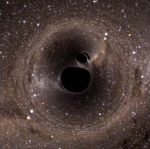 When Black Holes Collide
20.10.2015
What happens when two black holes collide? This extreme scenario likely occurs in the centers of some merging galaxies and multiple star systems. The featured video shows a computer animation of the final stages of such a merger, while highlighting the gravitational lensing effects that would appear on a background starfield.
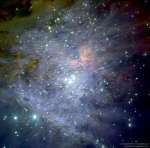 Magnetic Orion
27.02.2019
Can magnetism affect how stars form? Recent analysis of Orion data from the HAWC+ instrument on the airborne SOFIA observatory indicate that, at times, it can. HAWC+ is able to measure the polarization of far-infrared light which can reveal the alignment of dust grains by expansive ambient magnetic fields.
 APOD: 2024 September 3 Б Quarter Moon and Sister Stars
3.09.2024
Nine days ago, two quite different sky icons were imaged rising together. Specifically, Earth's Moon shared the eastern sky with the sister stars of the Pleiades cluster, as viewed from Alberta, Canada. Astronomical...
 APOD: 2025 December 3 Б Visualization: Near a Black Hole and Disk
3.12.2025
What would it look like to plunge into a monster black hole? This image from a supercomputer visualization shows the entire sky as seen from a simulated camera plunging toward a 4-million-solar-mass black hole, similar to the one at the center of our galaxy.
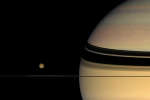 Moons, Rings, and Unexpected Colors on Saturn
20.10.2008
Why would Saturn show such strange colors? The robotic Cassini spacecraft currently orbiting Saturn has beamed back images showing that the northern hemisphere our Solar System's most spectacularly ringed planet has changed noticeably since Cassini arrived in 2004, now sporting unusual and unexpected colors. No one is sure why.
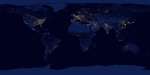 Earth at Night
7.12.2012
This remarkably complete view of Earth at night is a composite of cloud-free, nighttime images. The images were collected during April and October 2012 by the Suomi-NPP satellite from polar orbit about 824 kilometers (512 miles) above the surface using its Visible Infrared Imaging Radiometer Suite (VIIRS).
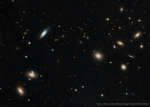 Inside the Coma Cluster of Galaxies
28.02.2015
Almost every object in the above photograph is a galaxy. The Coma Cluster of Galaxies pictured above is one of the densest clusters known - it contains thousands of galaxies. Each of these galaxies houses billions of stars - just as our own Milky Way Galaxy does.
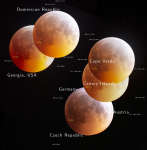 Lunar Eclipse Perspectives
5.02.2020
Do we all see the same Moon? Yes, but we all see it differently. One difference is the apparent location of the Moon against background stars -- an effect known as parallax. We humans use the parallax between our eyes to judge depth.
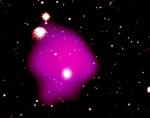 Hot Gas and Dark Matter
4.04.1999
Is the gravity of the galaxies seen in this image high enough to contain the glowing hot gas? Superposed on an optical picture of a group of galaxies is an image taken in X-ray light.
|
January February March April May June July August September |
|||||||||||||||||||||||||||||||||||||||||||||||||