
|
You entered: emission nebula
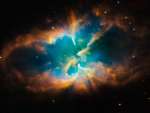 Planetary Nebula NGC 2818
22.01.2009
NGC 2818 is a beautiful planetary nebula, the gaseous shroud of a dying sun-like star. It could well offer a glimpse of the future that awaits our own Sun after spending another 5 billion years or so steadily using up hydrogen at its core, and then finally helium, as fuel for nuclear fusion.
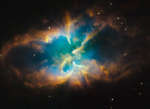 Planetary Nebula NGC 2818 from Hubble
13.07.2014
NGC 2818 is a beautiful planetary nebula, the gaseous shroud of a dying sun-like star. It could well offer a glimpse of the future that awaits our own Sun after spending another 5 billion years or so steadily using up hydrogen at its core, and then finally helium, as fuel for nuclear fusion.
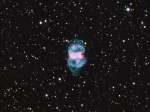 M76 Above and Below
21.11.2008
Also known by the popular name the "Little Dumbbell Nebula", M76 is one of the fainter objects listed in Charles Messier's 18th century Catalog of Nebulae and Star Clusters. Like its better-known namesake M27 (the Dumbbell Nebula), M76 is recognized as a planetary nebula - a gaseous shroud cast off by a dying sunlike star.
 APOD: 2025 July 5 Б Ou4: The Giant Squid Nebula
5.07.2025
Difficult to capture, this mysterious, squid-shaped interstellar cloud spans nearly three full moons in planet Earth's sky. Discovered in 2011 by French astro-imager Nicolas Outters, the Squid Nebula's bipolar shape is distinguished here by the telltale blue emission from doubly ionized oxygen atoms.
 APOD: 2024 June 17 Б Ou4: The Giant Squid Nebula
17.06.2024
Squids on Earth aren't this big. This mysterious squid-like cosmic cloud spans nearly three full moons on planet Earth's sky. Discovered in 2011 by French astro-imager Nicolas Outters, the Squid Nebula's bipolar shape is distinguished here by the telltale blue emission from doubly ionized oxygen atoms.
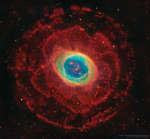 Rings Around the Ring Nebula
15.07.2018
There is much more to the familiar Ring Nebula (M57), however, than can be seen through a small telescope. The easily visible central ring is about one light-year across, but this remarkably deep exposure...
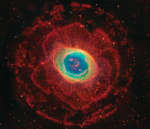 Rings Around the Ring Nebula
13.08.2014
It is a familiar sight to sky enthusiasts with even a small telescope. There is much more to the Ring Nebula (M57), however, than can be seen through a small telescope. The easily visible...
 APOD: 2023 December 26 Б IC 443: The Jellyfish Nebula
26.12.2023
Why is this jellyfish swimming in a sea of stars? Drifting near bright star Eta Geminorum, seen at the right, the Jellyfish Nebula extends its tentacles from the bright arcing ridge of emission left of center.
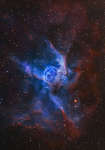 NGC 2359: Thor s Helmet
12.06.2020
NGC 2359 is a helmet-shaped cosmic cloud with wing-like appendages popularly called Thor's Helmet. Heroically sized even for a Norse god, Thor's Helmet is about 30 light-years across. In fact, the helmet...
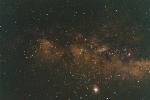 Hale-Bopp, Jupiter, and the Milky Way
23.07.1996
Shining brightly, the mighty Jupiter rules this gorgeous Kodacolor photo of the Milky Way near Sagittarius. Astronomer Bill Keel took the picture earlier this month (July 7) while standing near the summit of Hawaii's Mauna Kea contemplating the sky in the direction of the center of the Galaxy (right of picture center).
|
January February March April May June July August September October |
|||||||||||||||||||||||||||||||||||||||||||||||||