
|
You entered: image
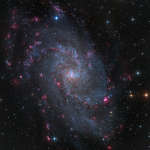 M33: The Triangulum Galaxy
12.11.2021
The small, northern constellation Triangulum harbors this magnificent face-on spiral galaxy, M33. Its popular names include the Pinwheel Galaxy or just the Triangulum Galaxy. M33 is over 50,000 light-years in diameter, third largest in the Local Group of galaxies after the Andromeda Galaxy (M31), and our own Milky Way.
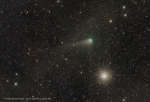 Messier 10 and Comet
21.07.2022
Imaged on July 15 2022, comet C/2017 K2 (PanSTARRS) had a Messier moment, sharing this wide telescopic field of view with globular star cluster Messier 10. Of course M10 was cataloged by 18th century comet hunter Charles Messier as the 10th object on his list of things that were definitely not comets.
 APOD: 2024 March 12 Б A Galaxy Shaped Rocket Exhaust Spiral
12.03.2024
What's that over the horizon? What may look like a strangely nearby galaxy is actually a normal rocket's exhaust plume -- but unusually backlit. Although the SpaceX Falcon 9 rocket was launched from...
 APOD: 2024 August 6 Б Storm Cloud Over Texas
6.08.2024
What makes this storm cloud so colorful? First, the cloud itself is composed of millions of tiny droplets of water and ice. Its bottom is almost completely flat -- but this isn't unusual. Bottom...
 APOD: 2025 January 13 Б Comet ATLAS Before Sunrise
13.01.2025
Comet ATLAS is really bright now, but also really close to the Sun. Outside the glow of the Sun, Comet C/2024 G3 (ATLAS) would be one of the more remarkable comet sights of recent years, reflecting about as much sunlight to Earth as Comet Tsuchinshan-ATLAS did in October, and now rivaling even planet Venus.
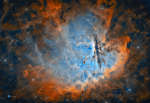 APOD: 2025 March 26 Б Star Formation in the Pacman Nebula
26.03.2025
You'd think the Pacman Nebula would be eating stars, but actually it is forming them. Within the nebula, a cluster's young, massive stars are powering the pervasive nebular glow. The eye-catching shapes...
 APOD: 2025 September 10 Б The Great Lacerta Nebula
10.09.2025
It is one of the largest nebulas on the sky -- why isn't it better known? Roughly the same angular size as the Andromeda Galaxy, the Great Lacerta Nebula can be found toward the constellation of the Lizard (Lacerta).
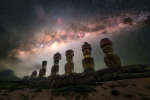 APOD: 2026 March 25 Б The Guardians of Rapa Nui beneath the Milky Way
25.03.2026
In the words of today's astrophotographer, Rositsa Dimitrova, "What have these silent sentinels watched pass across the sky?" The volcanic mo'ai (meaning statue) of Ahu Tongariki stand guard over Rapa Nui (Isla...
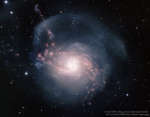 APOD: 2026 April 5 Б NGC 3310: A Starburst Spiral Galaxy
5.04.2026
The party is still going on in spiral galaxy NGC 3310. Roughly 100 million years ago, NGC 3310 likely collided with a smaller galaxy causing the large spiral galaxy to light up with a tremendous burst of star formation.
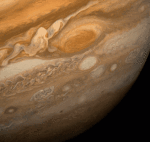 Jupiter's Colorful Clouds
3.08.1996
What makes the colors in Jupiter's clouds? With a mean temperature of 120 degrees Kelvin (-153 degrees Celsius) and a composition dominated by Hydrogen (about 90%), and Helium (about 10%) with a smattering...
|
January February March April May June July August September |
|||||||||||||||||||||||||||||||||||||||||||||||||