
|
You entered: image
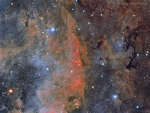 Colorful Star Clouds in Cygnus
22.04.2015
Stars can form in colorful surroundings. Featured here is a star forming region rich in glowing gas and dark dust toward the constellation of the Swan (Cygnus), near the bright star Sadr. This region, which spans about 50 light years, is part of the Gamma Cygni nebula which lies about 1,800 light years distant.
 Cat s Eye Wide and Deep
28.05.2016
The Cat's Eye Nebula (NGC 6543) is one of the best known planetary nebulae in the sky. Its more familiar outlines are seen in the brighter central region of the nebula in this impressive wide-angle view. But the composite image combines many short and long exposures to also reveal an extremely faint outer halo.
 M33: Triangulum Galaxy
17.09.2016
The small, northern constellation Triangulum harbors this magnificent face-on spiral galaxy, M33. Its popular names include the Pinwheel Galaxy or just the Triangulum Galaxy. M33 is over 50,000 light-years in diameter, third largest in the Local Group of galaxies after the Andromeda Galaxy (M31), and our own Milky Way.
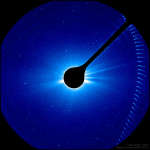 Comet Machholz Approaches the Sun
13.11.2017
Why is Comet Maccholz so depleted of carbon-containing chemicals? Comet 96P/Machholz's original fame derives from its getting closer to the Sun than any other short period comet -- half as close as Mercury -- and doing so every five years.
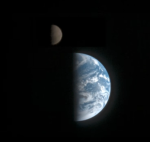 Earth and Moon
4.12.2017
On rare occasions, the Earth and Moon are photographed together. One of most spectacular times this occurred was 25 years ago this month when the Jupiter-bound Galileo spacecraft zoomed past our home planetary system. Then, robotic Galileo watched from about 15-times the Earth-Moon separation as our only natural satellite glided past our home world.
 Car Orbiting Earth
13.02.2018
Last week, a car orbited the Earth. The car, created by humans and robots on the Earth, was launched by the SpaceX Company to demonstrate the ability of its Falcon Heavy Rocket to place spacecraft out in the Solar System.
 Blue Moon Tree
28.03.2018
Does an alignment like this occur only once in a blue moon? No, although it was during a blue moon that this single-shot image was taken. During a full moon that happened...
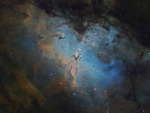 M16 Close Up
10.08.2019
A star cluster around 2 million years young surrounded by natal clouds of dust and glowing gas, M16 is also known as The Eagle Nebula. This beautifully detailed image of the region adopts the colorful Hubble palette and includes cosmic sculptures made famous in Hubble Space Telescope close-ups of the starforming complex.
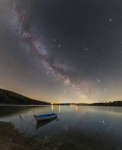 Lyrid Meteors from the Constellation Lyra
12.05.2020
Where are all of these meteors coming from? In terms of direction on the sky, the pointed answer is the constellation of Small Harp (Lyra). That is why the famous meteor shower that peaks every April is known as the Lyrids -- the meteors all appear to came from a radiant toward Lyra.
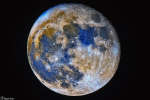 A Blue Moon in Exaggerated Colors
31.08.2021
The Moon is normally seen in subtle shades of grey or gold. But small, measurable color differences have been greatly exaggerated to make this telescopic, multicolored, moonscape captured during the Moon's full phase. The different colors are recognized to correspond to real differences in the chemical makeup of the lunar surface.
|
January February March April May June July August September |
|||||||||||||||||||||||||||||||||||||||||||||||||