
|
You entered: image
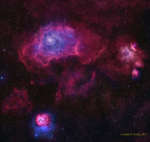 A Sagittarius Triplet
27.07.2017
These three bright nebulae are often featured on telescopic tours of the constellation Sagittarius and the crowded starfields of the central Milky Way. In fact, 18th century cosmic tourist Charles Messier cataloged two of them; M8, the large nebula above and left of center, and colorful M20 near the bottom of the frame.
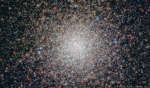 Star Cluster NGC 362 from Hubble
11.10.2017
If our Sun were near the center of NGC 362, the night sky would glow like a jewel box of bright stars. Hundreds of stars would glow brighter than Sirius, and in many different colors.
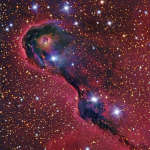 An Elephant s Trunk in Cepheus
16.01.2018
With image data from telescopes large and small, this close-up features the dusty Elephant's Trunk Nebula. It winds through the emission nebula and young star cluster complex IC 1396, in the high and far off constellation of Cepheus. Also known as vdB 142, the cosmic elephant's trunk is over 20 light-years long.
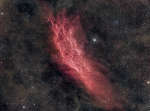 NGC 1499: The California Nebula
22.10.2022
Drifting through the Orion Arm of the spiral Milky Way Galaxy, this cosmic cloud by chance echoes the outline of California on the west coast of the United States. Our own Sun also lies within the Milky Way's Orion Arm, only about 1,500 light-years from the California Nebula.
 Most of Comet Tsuchinshan ATLAS
18.10.2024
On October 14 it was hard to capture a full view of Comet C/2023 A3 Tsuchinshan-ATLAS. Taken after the comet's closest approach to our fair planet, this evening skyview almost does though. With...
 Saturn at Night
2.11.2024
Saturn is bright in Earth's night skies. Telescopic views of the outer gas giant planet and its beautiful rings often make it a star at star parties. But this stunning view of Saturn's rings and night side just isn't possible from telescopes in the vicinity of planet Earth.
 APOD: 2026 April 18 Б PanSTARRS and Planets
18.04.2026
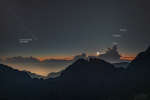
Near the eastern horizon before sunrise, Comet C/2025 R3 PanSTARRS is getting brighter. Readily visible in binoculars and small telescopes, the comet may be just on the verge of naked-eye visibility from dark sky sites.
 APOD: 2026 August 30 Б M74: A Grand Design Spiral
30.08.2026
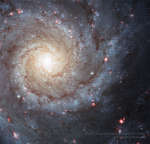
If not the most grand, then this spiral galaxy is at least one of the most photogenic. An island universe of about 100 billion stars, 32 million light-years away toward the constellation Pisces, M74 presents a gorgeous face-on view.
 Third Millennium, First Eclipse
4.01.2001
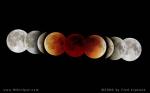
The first eclipse of the third millennium is coming up! A total lunar eclipse mainly visible from Europe, Asia, and Africa, will occur on January 9th as the full Moon glides through the long, but not so dark shadow of planet Earth. Why not so dark?
 Neptune's Great Dark Spot: Gone But Not Forgotten
8.05.1996
When NASA's Voyager 2 spacecraft flew by distant Neptune in August of 1989, astronomers were shocked. Since Neptune receives only 3 percent the sunlight Jupiter does, they expected to find a dormant, dark, frigid planet. Instead, the Voyager images revealed evidence of a dynamic and turbulent world.
|
January February March April May June July August September |
|||||||||||||||||||||||||||||||||||||||||||||||||