
|
You entered: image
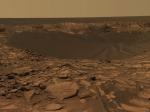 Beagle Crater on Mars
19.09.2006
What have we found on the way to large Victoria Crater? Smaller Beagle Crater. The robotic Opportunity rover rolling across Mars stopped at Beagle Crater early last month and took an impressively detailed 360-degree panorama of the alien Martian landscape. Beagle crater appears in the center as a dip exposing relatively dark sand.
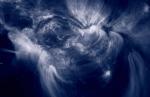 Solar Moss
27.12.1999
Discovered in recent close-up pictures of the Sun from NASA's Transition Region And Coronal Explorer (TRACE) spacecraft, this spongy-looking stuff has a temperature of 2 million degrees Fahrenheit ... and has been dubbed "Solar Moss". The false-color TRACE image above was recorded in extreme ultraviolet light on October 18.
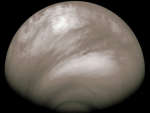 Mysterious Acid Haze on Venus
26.02.2008
Why did an acidic haze spread across Venus? The unusual clouds were discovered last July by ESA's robotic Venus Express spacecraft currently orbiting Venus. The bright and smooth haze was found by Venus...
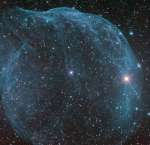 Sharpless 308
23.04.2009
Blown by fast winds from a hot, massive star, this cosmic bubble is huge. Cataloged as Sharpless 308 it lies some 5,200 light-years away in the constellation Canis Major and covers over 2/3 degree on the sky (compared with 1/2 degree for the Full Moon).
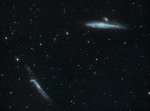 The Whale and the Hockey Stick
21.08.2009
NGC 4631 is a big beautiful spiral galaxy seen edge-on (top right) only 25 million light-years away towards the small northern constellation Canes Venatici. This galaxy's slightly distorted wedge shape suggests to some a cosmic herring and to others the popular moniker of The Whale Galaxy.
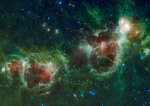 WISE: Heart and Soul Nebulas in Infrared
1.06.2010
Is the heart and soul of our Galaxy located in Cassiopeia? Possibly not, but that is where two bright emission nebulas nicknamed Heart and Soul can be found. The Heart Nebula, officially dubbed IC 1805 and visible in the above right, has a shape in optical light reminiscent of a classical heart symbol.
 Rainbow at Sunset
7.08.2010
Where is the Sun when you see a rainbow? Behind you, of course. But you can see both a rainbow and the Sun (far right) side by side in this graceful panorama recorded on July 28.
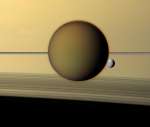 Ringside with Titan and Dione
5.01.2012
Orbiting in the plane of Saturn's rings, Saturnian moons have a perpetual ringside view of the gorgeous gas giant planet. Of course, while passing near the ring plane the Cassini spacecraft also shares their stunning perspective.
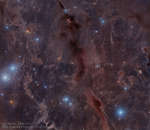 Dark Nebulas across Taurus
14.03.2016
Sometimes even the dark dust of interstellar space has a serene beauty. One such place occurs toward the constellation of Taurus. The filaments featured here can be found on the sky between the Pleiades star cluster and the California Nebula.
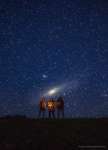 Andromeda Rising over Colombia
19.04.2016
Whats that rising over the hill? A galaxy. Never having seen a galaxy themselves, three friends of an industrious astrophotographer experienced an exhilarating night sky firsthand that featured not only the band of our Milky Way galaxy but also Milky Way's neighbor -- the Andromeda galaxy.
|
January February March April May June July August September |
|||||||||||||||||||||||||||||||||||||||||||||||||