
|
You entered: light
 Messier s Eleven
12.07.2013
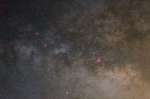
This fifteen degree wide field of view stretches across the crowded starfields of Sagittarius toward the center of our Milky Way galaxy. In fact, the center of the galaxy lies near the right edge of the rich starscape and eleven bright star clusters and nebulae fall near the center of the frame.
 A Phoenix Aurora over Iceland
16.03.2016
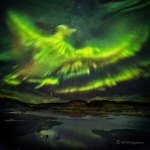
All of the other aurora watchers had gone home. By 3:30 am in Iceland, on a quiet night last September, much of that night's auroras had died down. Suddenly though, a new burst of particles streamed down from space, lighting up the Earth's atmosphere once again.
 UGC 1810: Wildly Interacting Galaxy from Hubble
10.05.2017
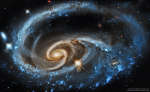
What's happening to this spiral galaxy? Although details remain uncertain, it surely has to do with an ongoing battle with its smaller galactic neighbor. The featured galaxy is labelled UGC 1810 by itself, but together with its collisional partner is known as Arp 273.
 Pluto in Enhanced Color
1.08.2021
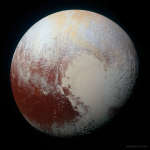
Pluto is more colorful than we can see. Color data and high-resolution images of our Solar System's most famous dwarf planet, taken by the robotic New Horizons spacecraft during its flyby in 2015 July, have been digitally combined to give an enhanced-color view of this ancient world sporting an unexpectedly young surface.
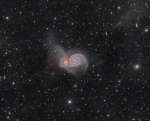 M51: The Whirlpool Galaxy
2.09.2022
Find the Big Dipper and follow the handle away from the dipper's bowl until you get to the last bright star. Then, just slide your telescope a little south and west and you'll come upon this stunning pair of interacting galaxies, the 51st entry in Charles Messier's famous catalog.
 APOD: 2024 August 18 Б A Solar Prominence Eruption from SDO
18.08.2024
One of the most spectacular solar sights is an erupting prominence. In 2011, NASA's Sun-orbiting Solar Dynamic Observatory spacecraft imaged an impressively large prominence erupting from the surface. The dramatic explosion was captured in ultraviolet light in the featured time lapse video covering 90 minutes, where a new frame was taken every 24 seconds.
 APOD: 2025 January 19 Б Titan Touchdown: Huygens Descent Movie
19.01.2025
What would it look like to land on Saturn's moon Titan? The European Space Agency's Huygens probe set down on the Solar System's cloudiest moon in 2005, and a time-lapse video of its descent images was created.
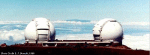 Keck: The Largest Optical Telescope
15.07.1996
In buildings eight stories tall rest mirrors ten meters across that are slowly allowing humanity to map the universe. Alone, each is the world's largest optical telescope: Keck. Together, the twin Keck telescopes have the resolving power of a single telescope 90-meter in diameter, able to discern sources just milliarcseconds apart.
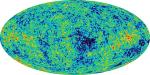 WMAP Resolves the Universe
12.02.2003
Analyses of a new high-resolution map of microwave light emitted only 380,000 years after the Big Bang appear to define our universe more precisely than ever before. The eagerly awaited results from the orbiting Wilkinson Microwave Anisotropy Probe resolve several long-standing disagreements in cosmology rooted in less precise data.
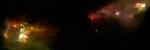 HH1/HH2: Star Jets
19.06.1997
A cloud of interstellar gas and dust collapses and a star is born. At its core temperatures rise, a nuclear furnace ignites, and a rotating dusty disk forms surrounding the newborn star. According...
|
January February |
|||||||||||||||||||||||||||||||||||||||||||||||||