
|
You entered: light
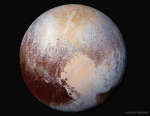 Pluto in Enhanced Color
30.08.2015
Pluto is more colorful than we can see. Color data and images of our Solar System's most famous dwarf planet, taken by the robotic New Horizons spacecraft during its flyby in July, have been digitally combined to give an enhanced view of this ancient world sporting an unexpectedly young surface.
 Pluto from above Cthulhu Regio
13.09.2015
New high resolution images of Pluto are starting to arrive from the outer Solar System. The robotic New Horizons spacecraft, which zoomed by Pluto in July, has finished sending back some needed engineering data and is now transmitting selections from its tremendous storehouse of images of Pluto and its moons.
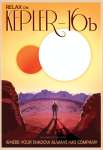 Where Your Shadow Has Company
19.02.2016
Want to take a relaxing interstellar vacation? Consider visiting Kepler-16b, a world in a binary star system. In fact Kepler-16b is the first discovered circumbinary planet. It was detected in a wide 229 day orbit around a close pair of cool, low-mass stars some 200 light-years away.
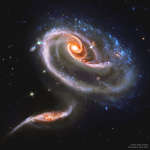 Arp 273: Battling Galaxies from Hubble
19.11.2019
What's happening to these spiral galaxies? Although details remain uncertain, there sure seems to be a titanic battle going on. The upper galaxy is labelled UGC 1810 by itself, but together with its collisional partners is known as Arp 273.
 APOD: 2025 January 13 Б Comet ATLAS Before Sunrise
12.01.2025
Comet ATLAS is really bright now, but also really close to the Sun. Outside the glow of the Sun, Comet C/2024 G3 (ATLAS) would be one of the more remarkable comet sights of recent years, reflecting about as much sunlight to Earth as Comet Tsuchinshan-ATLAS did in October, and now rivaling even planet Venus.
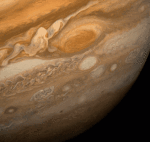 Jupiter's Colorful Clouds
3.08.1996
What makes the colors in Jupiter's clouds? With a mean temperature of 120 degrees Kelvin (-153 degrees Celsius) and a composition dominated by Hydrogen (about 90%), and Helium (about 10%) with a smattering...
 Denizen of the Tarantula Nebula
3.05.2003
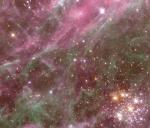
The star cluster at lower right, cataloged as Hodge 301, is a denizen of the Tarantula Nebula. An evocative nebula in the southern sky, the sprawling cosmic Tarantula is an energetic star forming region some 168,000 light-years distant in our neighboring galaxy the Large Magellanic Cloud.
 A Sky Full Of Hydrogen
28.02.1998
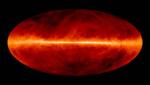
Interstellar space is filled with extremely tenuous clouds of gas which are mostly Hydrogen. The neutral hydrogen atom (HI in astronomer's shorthand) consists of 1 proton and 1 electron. The proton and electron spin like tops but can have only two orientations; spin axes parallel or anti-parallel.
 X Ray Pulsar
23.07.1998
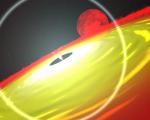
This dramatic artist's vision shows a city-sized neutron star centered in a disk of hot plasma drawn from its enfeebled red companion star. Ravenously accreting material from the disk, the neutron star spins faster and faster emitting powerful particle beams and pulses of X-rays as it rotates 400 times a second.
 A Tale of Two Hemispheres
30.07.2011
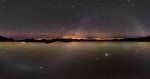
A quest to find planet Earth's darkest night skies led to this intriguing panorama. In projection, the mosaic view sandwiches the horizons visible in all-sky images taken from the northern hemisphere's Canary Island of La Palma (top) and the south's high Atacama Desert between the two hemispheres of the Milky Way Galaxy.
|
January February |
|||||||||||||||||||||||||||||||||||||||||||||||||