
|
You entered: light
 The SAR and the Milky Way
10.11.2023
This broad, luminous red arc was a surprising visitor to partly cloudy evening skies over northern France. Captured extending toward the zenith in a west-to-east mosaic of images from November 5, the faint atmospheric ribbon of light is an example of a Stable Auroral Red (SAR) arc.
 APOD: 2024 April 2 Б Detailed View of a Solar Eclipse Corona
1.04.2024
Only in the fleeting darkness of a total solar eclipse is the light of the solar corona easily visible. Normally overwhelmed by the bright solar disk, the expansive corona, the sun's outer atmosphere, is an alluring sight.
 Alpha Centauri: The Closest Star System
26.05.1996
The closest star system to the Sun is the Alpha Centauri system. Of the three stars in the system, the dimmest -- called Proxima Centauri -- is actually the nearest star. The bright stars Alpha Centauri...
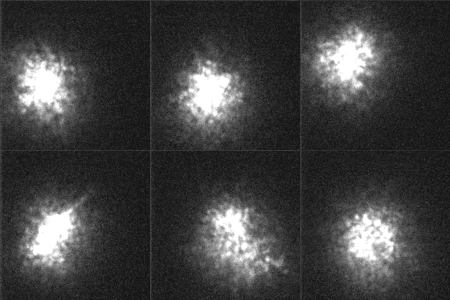 Why Stars Twinkle
25.07.2000
This is what a star really looks like from the surface of the Earth. To the best the human eye can see, stars are so far away they appear the same as would infinitesimal points of light.
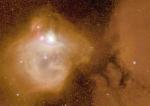 New Stars Destroying NGC 1748
3.04.2001
NGC 1748 cannot contain all the new stars it has formed. The young stars, the most massive of which are bright blue, emit so much energy they are pushing out and dispersing the gas and dust that comprise this star forming nebula.
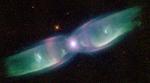 M2 9: Wings of a Butterfly Nebula
16.12.2000
Are stars better appreciated for their art after they die? Actually, stars usually create their most artistic displays as they die. In the case of low-mass stars like our Sun and M2-9 pictured above
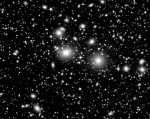 The Perseus Cluster of Galaxies
5.04.1996
Here is one of the largest objects that anyone will ever see on the sky. Each of the fuzzy blobs in the above picture is a galaxy, together making up the Perseus Cluster, one of the closest clusters of galaxies.
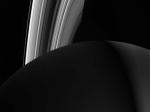 Saturn at Night
12.09.2006
This is what Saturn looks like at night. In contrast to the human-made lights that cause the nighttime side of Earth to glow faintly, Saturn's faint nighttime glow is primarily caused by sunlight reflecting off of its own majestic rings.
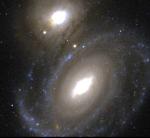 Galaxies Away
21.08.1999
This striking pair of galaxies is far, far away ... about 350 million light-years from Earth. Cataloged as AM0500-620, the pair is located in the southern constellation Dorado. The background elliptical and foreground spiral galaxy are representative of two of the three major classes of galaxies which inhabit our Universe.
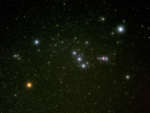 Camera Orion
15.10.2008
Orion, the Hunter, is one of the most easily recognizable constellations in planet Earth's night sky. But Orion's stars and nebulas don't look quite as colorful to the eye as they...
|
January February |
|||||||||||||||||||||||||||||||||||||||||||||||||