
|
You entered: star
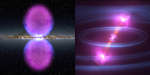 Fermi Science Finals
23.07.2018
The Fermi Science Playoffs celebrate 10 years of the Fermi Gamma-ray Space Telescope's exploration of the high-energy universe. Surviving all early rounds of voting, these two finalists in the competion square off at last.
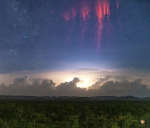 Red Sprite Lightning over Kununurra
25.02.2019
What are those red filaments in the sky? It is a rarely seen form of lightning confirmed only about 30 years ago: red sprites. Recent research has shown that following a powerful positive cloud-to-ground...
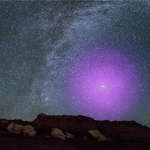 A Halo for Andromeda
3.09.2020
M31, the Andromeda Galaxy, is the closest large spiral galaxy to our Milky Way. Some 2.5 million light-years distant it shines in Earth's night sky as a small, faint, elongated cloud just visible to the unaided eye.
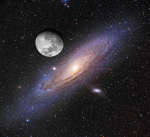 Moon over Andromeda
25.09.2020
The Great Spiral Galaxy in Andromeda (also known as M31), a mere 2.5 million light-years distant, is the closest large spiral to our own Milky Way. Andromeda is visible to the unaided...
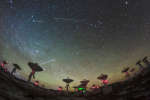 Quadrantids of the North
8.01.2022
Named for a forgotten constellation, the Quadrantid Meteor Shower puts on an annual show for planet Earth's northern hemisphere skygazers. The shower's radiant on the sky lies within the old, astronomically obsolete constellation Quadrans Muralis.
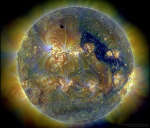 Venus and the Triply Ultraviolet Sun
6.03.2022
This was a very unusual type of solar eclipse. Typically, it is the Earth's Moon that eclipses the Sun. In 2012, though, the planet Venus took a turn. Like a solar eclipse by the Moon, the phase of Venus became a continually thinner crescent as Venus became increasingly better aligned with the Sun.
 SOFIA s Southern Lights
29.07.2022
SOFIA, the Stratospheric Observatory for Infrared Astronomy, is a Boeing 747SP aircraft modified to carry a large reflecting telescope into the stratosphere. The ability of the airborne facility to climb above about 99 percent of Earth's infrared-blocking atmosphere has allowed researchers to observe from almost anywhere over the planet.
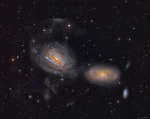 Unraveling NGC 3169
2.03.2023
Spiral galaxy NGC 3169 looks to be unraveling like a ball of cosmic yarn. It lies some 70 million light-years away, south of bright star Regulus toward the faint constellation Sextans. Wound up spiral arms are pulled out into sweeping tidal tails as NGC 3169 (left) and neighboring NGC 3166 interact gravitationally.
 Unraveling NGC 3169
23.05.2024
Spiral galaxy NGC 3169 looks to be unraveling like a ball of cosmic yarn. It lies some 70 million light-years away, south of bright star Regulus toward the faint constellation Sextans. Wound up spiral arms are pulled out into sweeping tidal tails as NGC 3169 (left) and neighboring NGC 3166 interact gravitationally.
 The Deep Field
24.01.1996
The image above is part of the Hubble Deep Field and represents humanity's most distant yet optical view of the Universe. Galaxies like colorful pieces of candy fill the field, some as faint as 30th magnitude (about four billion times fainter than stars visible to the unaided eye).
|
January February March April May June July August September |
|||||||||||||||||||||||||||||||||||||||||||||||||