
|
You entered: star
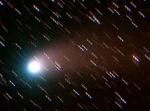 Comet McNaught Hartley
14.03.2001
Outbound and climbing above the plane of our solar system, comet McNaught-Hartley (C/1999 T1) is presently soaring through northern skies. This telescopic picture, a composite of many 30 second exposures made through three color filters, recorded the delicate colors in its diminutive coma and faint tail on February 26th.
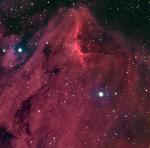 The Pelican in the Swan
29.08.2002
The Pelican Nebula, also known as IC 5070, lies about 2,000 light-years away in the high and far-off constellation of Cygnus, the Swan. This picture spans a portion of the magnificent nebula about 30 light-years wide.
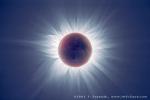 Moon AND Sun
22.11.2003
This composite image was made from 22 separate pictures of the Moon and Sun all taken from Chisamba, Zambia during the total phase of the 2001 June 21 solar eclipse. The multiple exposures were...
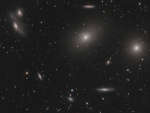 In the Heart of the Virgo Cluster
8.07.2008
The Virgo Cluster of Galaxies is the closest cluster of galaxies to our Milky Way Galaxy. The Virgo Cluster is so close that it spans more than 5 degrees on the sky - about 10 times the angle made by a full Moon.
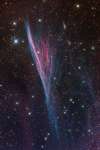 NGC 2736: The Pencil Nebula
8.01.2009
This shock wave plows through space at over 500,000 kilometers per hour. Moving right to left in the beautifully detailed color composite, the thin, braided filaments are actually long ripples in a sheet of glowing gas seen almost edge on. Cataloged as NGC 2736, its narrow appearance suggests its popular name, the Pencil Nebula.
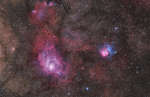 A Sagittarius Triplet
1.06.2012
These three bright nebulae are often featured in telescopic tours of the constellation Sagittarius and the crowded starfields of the central Milky Way. In fact, 18th century cosmic tourist Charles Messier cataloged two of them; M8, the large nebula left of center, and colorful M20 on the right.
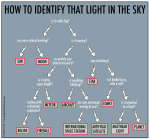 How to Identify that Light in the Sky
9.06.2014
What is that light in the sky? Perhaps one of humanity's more common questions, an answer may result from a few quick observations. For example -- is it moving or blinking?
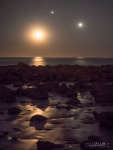 Triple Conjunction Over Galician National Park
24.06.2015
What are those bright objects hovering over the horizon? Planets -- and the Moon. First out, the horizon featured is a shoreline of the Atlantic Ocean that occurs at the Galicia National Park in northern Spain. Next furthest out, on the left, is the Moon.
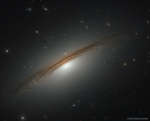 UGC 12591: The Fastest Rotating Galaxy Known
7.03.2017
Why does this galaxy spin so fast? To start, even identifying which type of galaxy UGC 12591 is difficult -- it has dark dust lanes like a spiral galaxy but a large diffuse bulge of stars like a lenticular.
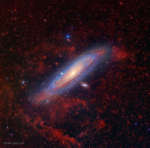 Clouds of Andromeda
8.01.2018
What are those red clouds surrounding the Andromeda galaxy? This galaxy, M31, is often imaged by planet Earth-based astronomers. As the nearest large spiral galaxy, it is a familiar sight with dark dust lanes, bright yellowish core, and spiral arms traced by clouds of bright blue stars.
|
January February March April May June July August September |
|||||||||||||||||||||||||||||||||||||||||||||||||