
|
You entered: time
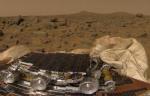 A Landing On Mars
4.07.1999
On July 4th, 1997 - using its own array of fireworks, a parachute, and airbags - the Mars Pathfinder spacecraft successfully came to rest on the surface of Mars at 10:07 AM Pacific Daylight Time. Ninety minutes before reaching the surface Pathfinder began a flurry of activity.
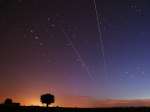 Chasing the ISS
4.06.2008
Bathed in sunlight, the International Space Station (ISS) arced through the evening sky above the town of Lauffen in southern Germany on May 31st. The timing of the bright passage was about 10 minutes after the launch of the Space Shuttle Discovery on the STS-124 mission from Kennedy Space Center, Florida, in the southeastern US.
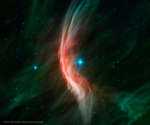 Zeta Oph: Runaway Star
5.07.2015
Like a ship plowing through cosmic seas, runaway star Zeta Ophiuchi produces the arcing interstellar bow wave or bow shock seen in this stunning infrared portrait. In the false-color view, bluish Zeta...
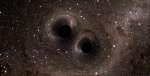 Simulation: Two Black Holes Merge
14.04.2019
Sit back and watch two black holes merge. Inspired by the first direct detection of gravitational waves in 2015, this simulation video plays in slow motion but would take about one third of a second if run in real time.
 The Sky from Mauna Kea
11.05.2015
What if you could stand at the top of a volcano and peer out across the universe? It the timing is right, you might see an amazing panorama like the one featured here.
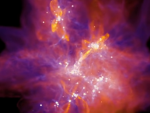 STARFORGE: A Star Formation Simulation
23.06.2021
How do stars form? Most form in giant molecular clouds located in the central disk of a galaxy. The process is started, influenced, and limited by the stellar winds, jets, high energy starlight, and supernova explosions of previously existing stars.
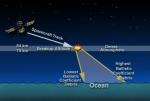 Compton Reentry
3.06.2000
Nine years ago the massive Compton Gamma Ray Observatory, the second of NASA's space-based great observatories, was deployed in low earth orbit. Lofted above the protective atmosphere, Compton's instruments could explore the extreme high-energy Universe in gamma rays -- photons with 100,000 times or more the energy of visible light.
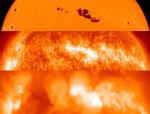 Sunspot Stack
19.04.2001
Welcome to multiwavelength astronomy! From top to bottom, these stacked panels show the largest sunspot group in a decade in visible, extreme ultraviolet, and x-ray light. All were taken on March 29, around...
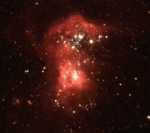 Bright Stars, Dim Galaxy
14.10.1996
These two clusters of bright, newly formed stars surrounded by a glowing nebula lie 10 million light years away in the dim, irregular galaxy cataloged as NGC 2366. The Hubble Space Telescope image shows...
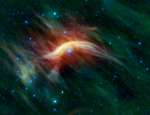 Zeta Oph: Runaway Star
4.02.2011
Like a ship plowing through cosmic seas, runaway star Zeta Ophiuchi produces the arcing interstellar bow wave or bow shock seen in this stunning infrared portrait from the WISE spacecraft. In the false-color view...
|
January February March April May June July August September |
|||||||||||||||||||||||||||||||||||||||||||||||||