
|
You entered: supernova
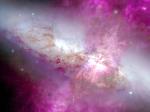 The Supergalactic Wind from Starburst Galaxy M82
1.06.2004
Star formation occurs at a faster pace in M82 -- a galaxy with about ten times the rate of massive star birth (and death) compared to our Milky Way. Winds from massive stars and blasts from supernova explosions have created a billowing cloud of expanding gas from this remarkable starburst galaxy.
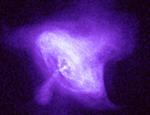 The Crab Nebula in X Rays
29.09.1999
Why does the Crab Nebula still glow? In the year 1054 A.D. a supernova was observed that left a nebula that even today glows brightly in every color possible, across the entire electromagnetic spectrum. At the nebula's center is an ultra-dense neutron star that rotates 30 times a second.
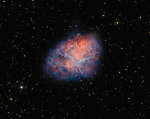 M1: The Crab Nebula
20.11.2014
The Crab Nebula is cataloged as M1, the first object on Charles Messier's famous 18th century list of things which are not comets. In fact, the Crab is now known to be a supernova remnant, debris from the death explosion of a massive star, witnessed by astronomers in the year 1054.
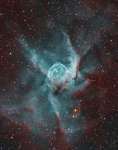 NGC 2359: Thor s Helmet
16.02.2019
NGC 2359 is a helmet-shaped cosmic cloud with wing-like appendages popularly called Thor's Helmet. Heroically sized even for a Norse god, Thor's Helmet is about 30 light-years across. In fact, the helmet...
 APOD: 2026 February 20 Б B93: A Dark Interstellar Ghost
20.02.2026
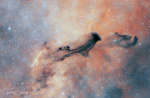
"A ghost in the Milky WayББ says Christian Bertincourt, the astrophotographer behind this striking image of Barnard 93 (B93). The 93rd entry in BarnardБs Catalogue of Dark Nebulae, B93 lies within the Small Sagittarius Star Cloud (Messier 24), where its darkness stands in stark contrast to bright stars and gas in the background.
 In the Heart of the Crab
5.06.2000
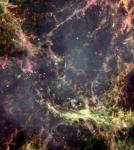
The supernova explosion that formed the Crab Nebula was first seen on the year 1054. Last week, astronomers released a new image of the still-evolving center of the explosion. The above representative-color photograph...
 In the Center of the Omega Nebula
1.05.2002
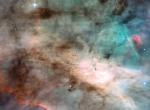
In the depths of the dark clouds of dust and molecular gas known as the Omega Nebula, stars continue to form. The above image from the Hubble Space Telescope's newly installed Advanced Camera for Surveys shows unprecedented detail in the famous star-forming region.
 Chandras First Light: Cassiopeia A
27.08.1999
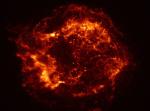
Cosmic wreckage from the detonation of a massive star is the subject of this official first image from NASA's Chandra X-ray Observatory. The supernova remnant, known as Cassiopeia A, was produced when a star exploded around 300 years ago in this northern sky constellation.
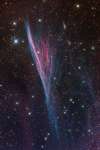 NGC 2736: The Pencil Nebula
8.01.2009
This shock wave plows through space at over 500,000 kilometers per hour. Moving right to left in the beautifully detailed color composite, the thin, braided filaments are actually long ripples in a sheet of glowing gas seen almost edge on. Cataloged as NGC 2736, its narrow appearance suggests its popular name, the Pencil Nebula.
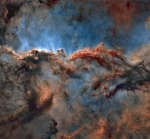 APOD: 2024 June 19 Б NGC 6188: Dragons of Ara
19.06.2024
Do dragons fight on the altar of the sky? Although it might appear that way, these dragons are illusions made of thin gas and dust. The emission nebula NGC 6188, home to the glowing...
|
January February March April May June July August September October |
|||||||||||||||||||||||||||||||||||||||||||||||||