
|
You entered: supernova
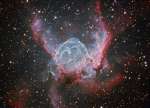 Thor s Helmet
5.06.2010
This helmet-shaped cosmic cloud with wing-like appendages is popularly called Thor's Helmet. Heroically sized even for a Norse god, Thor's Helmet is about 30 light-years across. In fact, the helmet is actually...
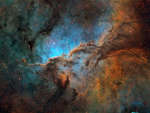 Shaping NGC 6188
16.07.2010
Dark shapes with bright edges winging their way through dusty NGC 6188 are tens of light-years long. The emission nebula is found near the edge of an otherwise dark large molecular cloud in the southern constellation Ara, about 4,000 light-years away.
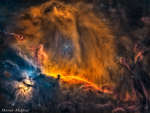 A Lion in Orion
7.03.2022
Yes, but can you see the lion? A deep exposure shows the famous dark indentation that looks like a horse's head, visible just left and below center, and known unsurprisingly as the Horsehead Nebula. The Horsehead Nebula (Barnard 33) is part of a vast complex of dark absorbing dust and bright glowing gas.
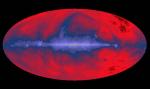 The Radio Sky: Tuned to 408MHz
20.10.2001
Tune your radio telescope to 408MHz (408 million cycles per second) and check out the Radio Sky! You should find that frequency on your dial somewhere between US broadcast television channels 13 and 14.
 Chamaeleon Dark Nebulas
17.01.2022
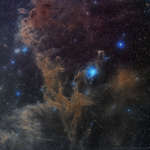
Sometimes the dark dust of interstellar space has an angular elegance. Such is the case toward the far-south constellation of Chamaeleon. Normally too faint to see, dark dust is best known for blocking visible light from stars and galaxies behind it.
 Mu Cephei
12.10.2023
Mu Cephei is a very large star. An M-class supergiant some 1500 times the size of the Sun, it is one of the largest stars visible to the unaided eye, and even one of the largest in the entire Galaxy.
 NGC 1818: Pick A Star
15.04.1998
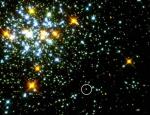
This is NGC 1818, a youthful, glittering cluster of 20,000 stars residing in the Large Magellanic Cloud, 164,000 light-years away. Pick a star. Any star. Astronomers might pick the unassuming bluish-white one (circled) which appears to be a hot newly formed white dwarf star. What makes it so interesting?
 Sharpless 308
23.04.2009
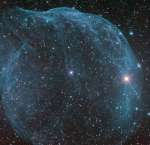
Blown by fast winds from a hot, massive star, this cosmic bubble is huge. Cataloged as Sharpless 308 it lies some 5,200 light-years away in the constellation Canis Major and covers over 2/3 degree on the sky (compared with 1/2 degree for the Full Moon).
 A Pulsar s Hand
1.05.2010
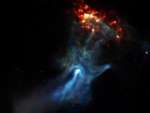
As far as pulsars go, PSR B1509-58 appears young. Light from the supernova explosion that gave birth to it would have first reached Earth some 1,700 years ago. The magnetized, 20 kilometer-diameter neutron star spins 7 times per second, a cosmic dynamo that powers a wind of charged particles.
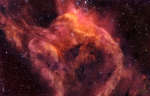 NGC 3572 and the Southern Tadpoles
6.05.2022
This cosmic skyscape features glowing gas and dark dust clouds along side the young stars of NGC 3572. A beautiful emission nebula and star cluster it sails far southern skies within the nautical constellation Carina.
|
January February March April May June July August September October |
|||||||||||||||||||||||||||||||||||||||||||||||||