
|
You entered: filaments
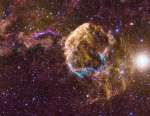 Sibling Supernova Remnants
2.07.2026
What happens when one of the stars in a binary goes supernova? This image combines visible (yellow), ultraviolet (purple) and infrared light (cyan, red and orange) to show two supernova remnants and their surrounding environment, about 6,000 light-years away. The younger one is the well-known Jellyfish Nebula in the center (mostly in yellow).
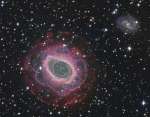 Ring Nebula Deep Field
6.11.2009
A familiar sight to sky enthusiasts with even a small telescope, the Ring Nebula (M57) is some 2,000 light-years away in the musical constellation Lyra. The central ring is about one light-year across...
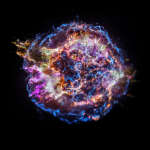 Recycling Cassiopeia A
28.12.2017
Massive stars in our Milky Way Galaxy live spectacular lives. Collapsing from vast cosmic clouds, their nuclear furnaces ignite and create heavy elements in their cores. After a few million years, the enriched material is blasted back into interstellar space where star formation can begin anew.
 NGC 253: Close Up
19.05.2011
This dusty island universe is one of the brightest spiral galaxies in planet Earth's sky. Seen nearly edge-on, NGC 253 is only 13 million light-years away, the largest member of the Sculptor Group of galaxies, neighbor to our own local galaxy group.
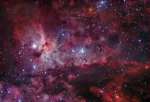 The Great Carina Nebula
9.06.2011
A jewel of the southern sky, the Great Carina Nebula, also known as NGC 3372, spans over 300 light-years, one of our galaxy's largest star forming regions. Like the smaller, more northerly Great...
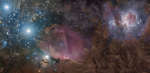 Orion in Gas, Dust, and Stars
29.09.2009
The constellation of Orion holds much more than three stars in a row. A deep exposure shows everything from dark nebula to star clusters, all imbedded in an extended patch of gaseous wisps in the greater Orion Molecular Cloud Complex.
 APOD: 2025 August 24 Б The Spinning Pulsar of the Crab Nebula
24.08.2025
At the core of the Crab Nebula lies a city-sized, magnetized neutron star spinning 30 times a second. Known as the Crab Pulsar, it is the bright spot in the center of the gaseous swirl at the nebula's core.
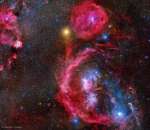 A 212 Hour Exposure of Orion
29.03.2020
The constellation of Orion is much more than three stars in a row. It is a direction in space that is rich with impressive nebulas. To better appreciate this well-known swath of sky, an extremely long exposure was taken over many clear nights in 2013 and 2014.
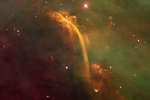 HH 222: The Waterfall Nebula
24.10.2011
What created the Waterfall Nebula? No one knows. The structure seen in the region of NGC 1999 in the Great Orion Molecular Cloud complex is one of the more mysterious structures yet found on the sky. Designated HH-222, the elongated gaseous stream stretches about ten light years and emits an unusual array of colors.
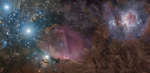 Orion in Gas, Dust, and Stars
12.02.2012
The constellation of Orion holds much more than three stars in a row. A deep exposure shows everything from dark nebula to star clusters, all embedded in an extended patch of gaseous wisps in the greater Orion Molecular Cloud Complex.
|
January February March April May June July August September October |
|||||||||||||||||||||||||||||||||||||||||||||||||